Hours With the Same Voice Punish Every Small Flaw
An audiobook asks more of a synthetic voice than almost any other format. Listeners stay with the same narrator for hours, so a voice that sounds slightly off wears thin long before the last chapter.
That changes what matters when you choose a tool. A clean demo sentence means little if the delivery flattens across a full chapter or stumbles over your characters’ names. Length, not polish, is the real test.
This guide compares the leading AI voice generators for audiobook work. It makes no hands-on claims, only a careful read of how each tool is built, licensed, and suited to long-form narration as of 2026.
Expressive for Fiction, Steady for Nonfiction

Reach for ElevenLabs if you want the most expressive, natural narration, which helps most with story-driven or emotionally layered books.
Reach for Speechify or Play.ht if you value speed, a broad voice library, and a workflow built for turning long documents into audio quickly.
Whatever you choose, confirm two things before you produce the whole book: the commercial license must cover audiobook sales, and your retailer’s policy on AI narration must allow it.
Four Traits That Decide an Audiobook Voice
Before naming tools, it helps to know which traits actually decide an audiobook voice. Four stand out, and each can settle the choice on its own.
The first is consistency over hours of audio. A voice can sound warm on page one and drift into monotony by chapter three. Test each tool on a full chapter so you hear how it holds up.
The second is pronunciation control. Books repeat character names, places, and invented terms that generic models mangle. A tool that lets you fix pronunciations saves you from re-rendering the same mistake dozens of times.
The third is licensing for distribution. Selling an audiobook needs a license that clearly covers commercial audiobook use. Some free or entry tiers permit personal use only, which quietly puts your sales at risk.
The fourth is chapter-level re-rendering. You will catch bad lines only when you listen in context. Favor a tool that lets you regenerate a single sentence or paragraph rather than the whole chapter each time.
The Narration Engines Worth Auditioning
ElevenLabs is widely regarded for expressive, natural narration that carries emotion across long passages. That makes it a common first choice for fiction and memoir. If narration is your priority, our roundup of the best AI voice generators shows how it compares across other use cases.
Speechify is built around turning long text into speech quickly, with a large voice library and a focus on listening at length. It suits authors who want a fast path from manuscript to audio.
Play.ht offers many voices and flexible export options, which helps when you want variety across a series or need specific output formats for different retailers.
Murf pairs solid voices with a timeline editor, so you can adjust pacing and align narration with any added sound. It fits authors who want more control over the final mix.
WellSaid Labs focuses on clean, professional narration with clear commercial licensing, which makes it a steady pick for nonfiction, business, and reference titles.
Many authors face a related choice first. Our take on AI narration vs a human voice actor weighs cost, quality, and rights before you pick any tool.
How the Tools Line Up for Audiobook Production

The table below maps how these tools line up for audiobook production.
| Tool | Delivery style | Long-form strength | Pronunciation control | Best fit for |
|---|---|---|---|---|
| ElevenLabs | Expressive, emotive | Strong | Strong | Fiction, memoir, story-driven books |
| Speechify | Clear, brisk | Good | Good | Fast manuscript-to-audio conversion |
| Play.ht | Varied library | Good | Good | Series needing voice variety |
| Murf | Steady, produced | Good | Good | Authors who want mix control |
| WellSaid Labs | Professional | Good | Good | Nonfiction and reference titles |
Start With Your Genre, Not the Feature List
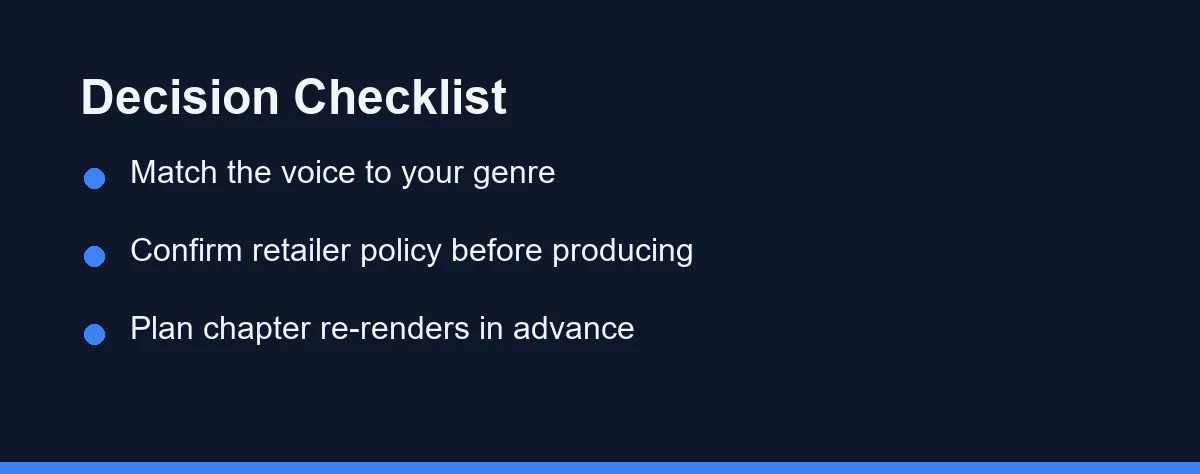
Start with your genre. Fiction with dialogue and shifting emotion is the hardest case for AI, which points toward the most expressive option. Steady nonfiction is far more forgiving and widens your choices.
Next, check your distribution plan before anything else. If a retailer will not accept AI narration for your program, the best voice in the world does not help. Confirm current rules, then choose a tool.
Then weigh your production stack. If you plan to add music, effects, or careful pacing, a tool with a built-in editor helps. If you only need clean narration, a voice-focused tool with good exports may be simpler.
Finally, test on a real chapter. Narrate your hardest section, listen end to end, and check how easily you can re-render one line. That reveals more than any feature list.
Where AI Narration Trips Up Authors
Knowing the common failures helps you plan around them instead of finding them after you produce the whole book. A few patterns recur in audiobook work.
The first is flat long-form pacing. A voice that shines for a page can settle into a monotone across a chapter. Break long sentences, add punctuation, and vary rhythm so the read breathes.
The second is mispronounced names. Recurring characters, places, and invented words often come out wrong. Build a pronunciation list from the start rather than fixing each error later.
The third is license surprises. Some authors build a book on a free tier, then learn it never covered sales. Sort licensing before you export, not after your first order.
The fourth is retailer policy risk. Platform rules on AI and digital narration shifted through 2025 and 2026, and they differ by store and program. Confirm the current policy of Audible, Apple Books, Google Play Books, and Spotify before you commit.
A fifth, quieter issue is emphasis. AI voices often stress the wrong word, which reads as slightly off even when every word is correct. Rephrasing or splitting the line usually fixes it.
Why Quotas Matter More Than Monthly Price Here
Pricing and quotas change often here, so treat this as general positioning and confirm current pricing on the official site before committing. These notes reflect the landscape as of 2026.
| Tier | Typical use | What to check |
|---|---|---|
| Free | Testing voices and a sample chapter | Character limits, commercial rights |
| Individual paid | Producing a full book | Monthly characters, audiobook license |
| Team or pro | Multiple titles or a series | Seats, output formats, license scope |
For a full-length book, the free tier is a trial, not a home. The wall you hit is usually a monthly character limit, since audiobooks run long, so plan for a paid plan once you move past testing.
The published entry points show that pattern (as of Aug 2026). ElevenLabs’ free tier is $0 without a commercial licence, and its Starter plan at $6/month is the first tier that includes one. Murf’s free plan stops at 10 minutes of voice generation with no commercial rights, while its Creator plan at $19/month billed annually includes 24 hours a year. WellSaid’s Starter is $10/month billed annually with full commercial rights, and its free trial covers 3 download minutes a month.
When you compare paid tiers, weigh the character allowance and license scope more than the voice count. One natural voice you can legally sell beats a hundred you cannot.
Which Narrator Voice Fits Your Book
The right tool depends on your book more than on any single feature. Here are direct calls.
You write fiction or memoir with emotional range: choose ElevenLabs. Its expressive delivery carries dialogue and mood where a flatter voice would lose listeners.
You want the fastest path from manuscript to audio: choose Speechify. Its long-form focus turns a finished draft into a full narration quickly.
You publish a series and want distinct voices: choose Play.ht. Its large library supports variety without juggling several tools.
You plan to add music or fine-tune pacing: choose Murf. Its timeline editor gives you control over the final mix.
You produce nonfiction, business, or reference books: choose WellSaid Labs. Its professional tone and clear commercial licensing fit steady, informative content.
Habits That Trip Up Audiobook Authors
A few habits trip up authors using AI narration. Watch for them.
Do not judge on a demo sentence. Narrate a full chapter from your own book, because the robotic feel usually shows up over length, not in one line.
Do not skip the retailer check. Confirm your target store accepts AI narration for your program before you produce, since redoing a whole book is costly.
Do not ignore the license. Verify your plan covers audiobook sales before you export, because fixing rights after a sale is far harder than reading the terms first.
Natural for Hours, and Right on the Names
For audiobooks, the best AI voice generator is the one that stays natural across hours of listening and says your characters’ names right. It also needs a license and a platform path that let you sell. ElevenLabs leads on expressive narration, while Speechify, Play.ht, Murf, and WellSaid each win for specific genres and workflows.
The smart move is to narrate one real chapter with two tools, listen at full length, and confirm both the license and the retailer’s policy before you produce the rest. Get consistency, rights, and pronunciation right, and listeners stop noticing the tool and start hearing your story. An audiobook exposes the pricing model faster than any other project, because a full manuscript burns through an allowance that looked generous on a demo script. Whether your plan counts characters, credits, or minutes changes what a finished book actually costs to produce.
FAQ
What is the best AI voice generator for audiobooks?
There is no single winner, but expressive long-form narration tends to favor ElevenLabs, while Speechify and Play.ht suit creators who want speed and a large voice library. The right pick depends on your genre and your distribution platform. Test each tool on a full chapter, not a single paragraph, before you commit.
Can I sell an AI-narrated audiobook on Audible or Apple Books?
It depends on where you plan to sell. Some retailers accept AI or digitally narrated audiobooks through specific programs, while others still expect human narration. Rules shifted through 2025 and 2026, so confirm the current policy of Audible, Apple Books, Google Play Books, and Spotify before you produce the whole book.
Why does my AI audiobook narration sound robotic over long chapters?
Consistency is the hardest part. A voice that sounds warm for one page can drift into a flat rhythm across hours of audio, and mispronounced character names break immersion. Build a pronunciation list, split long sentences, and listen to full chapters rather than trusting a short demo.
Is AI narration good enough for fiction audiobooks?
Fiction with dialogue and emotion is the hardest case for synthetic voices, since it needs shifts in tone that AI still handles unevenly. Nonfiction, self-help, and reference titles are more forgiving because the delivery stays steady. Many authors start with nonfiction and revisit fiction as the tools improve.
Do I need a commercial license to publish an AI-narrated audiobook?
Usually yes, if your plan includes a commercial license that covers audiobook distribution and monetization. Free tiers often allow personal use only, which is a trap once you sell copies. Read the license scope on the official site before you export the final files.
Sources
- ElevenLabs pricing — checked 2026-09-27
- Murf Help Center: Voice Generation Time (VGT) — checked 2026-09-27
Some links may be affiliate links. We may earn a commission at no extra cost to you.
This article was written with AI assistance. It is researched and fact-checked, not based on personal hands-on testing unless explicitly stated.
Comments
Post a Comment