Two Confident Camps, Neither Reading the Documentation
The short answer: no, AI writing tools do not hurt your SEO on their own. Google’s own documentation says the method of production is not the signal. The risk lives one policy over, in scaled content abuse, where unedited volume gets enforced regardless of who wrote it.
Ask this question in any marketing forum and you get two confident answers. One camp swears Google punishes anything a model touched. The other insists nothing has changed.
Both camps usually argue from anecdote. Meanwhile Google has published its position in plain language, and almost nobody quotes it directly.
The stakes are real for small publishers. Guessing wrong in one direction wastes months of drafting speed, and guessing wrong in the other buries a site nobody can find.
This guide works from the published documentation rather than folklore. It separates what Google says about AI content from what it says about scaled content abuse, then turns the distinction into a workflow you can run.
The Method of Production Is Not the Signal
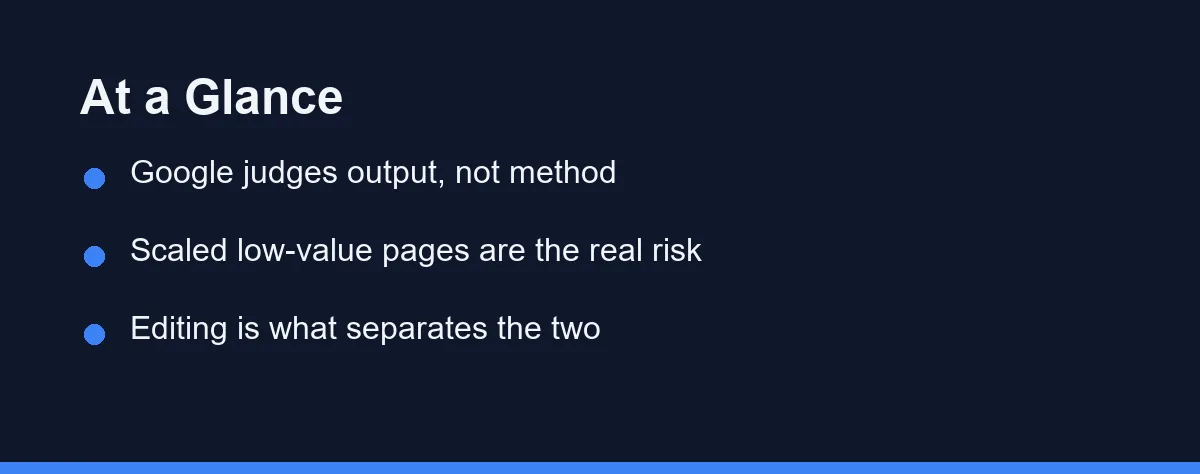
Google’s guidance says it rewards high-quality content however it is produced. The method of production is not the ranking signal, and the quality of the result is.
The real risk sits in a different policy. Google’s spam policies describe scaled content abuse, which covers mass-producing pages mainly to manipulate rankings, regardless of whether a machine or a person wrote them.
So an AI writing tool does not hurt your SEO by itself. Publishing forty thin, interchangeable pages a week does, and a tool simply makes that failure faster to reach.
The workflow that survives pairs machine drafting speed with human expertise, verification, and a point of view. The workflow that fails skips the second half.
What Google’s Documentation Actually Says
Google addressed this directly in a February 2023 post titled Google Search and AI-generated content. The core claim is that appropriate use of AI is not against its guidelines.
The post ties quality back to E-E-A-T: experience, expertise, authoritativeness, and trustworthiness. Those signals reward content that demonstrates genuine knowledge, and a model alone cannot supply firsthand experience.
Google’s spam policies carry the enforceable rules. In 2024 the policy language moved from spammy automatically-generated content to scaled content abuse, which explicitly covers content made by automation, by humans, or by a combination.
That rewrite is the whole story in one edit. The policy stopped caring who typed the words and started caring whether the pages serve readers or search engines.
Where the Real Ranking Risk Lives
Three failure patterns explain most AI-related traffic collapses, and none of them are about the tool.
The first is volume without value. A site that jumps from four posts a month to eighty signals a change in intent, and the pages usually read as interchangeable because they are.
The second is missing expertise. Model output summarizes what already exists on the web, so an article built only from it adds nothing new to the index. Search engines have no reason to rank a restatement above the source.
The third is unverified claims. Models produce fluent, confident errors, and a wrong price or a fabricated statistic damages trust with both readers and reviewers. Our comparison of AI detectors vs plagiarism checkers covers the related question of originality tooling.
A fourth pattern deserves a mention because it looks harmless. Publishing the same article structure over and over, with only the target audience swapped, creates a set of near-duplicates that dilute each other.
What to Look For in Your Workflow
Ask who verifies each factual claim before publication. If the honest answer is nobody, the workflow has a hole no tool closes.
Ask what the article contains that a model could not generate. Original data, a real decision framework, a named comparison, or documented experience all qualify. Pure summary does not.
Ask whether your publishing rate matches your editing capacity. Drafting speed scales easily and editorial judgment does not, so the two fall out of step quickly.
Ask whether each page targets a distinct search intent. Two articles competing for one query split their own signals, which helps neither.
Finally, ask whether a reader would finish the piece better informed. That test predicts search performance more reliably than any checklist, and our best AI writing tools roundup covers which tools support that kind of drafting.
Common Workflows Ranked by Actual Risk

Workflows carry very different risk profiles. The table compares the common ones.
| Workflow | Policy risk | Quality ceiling | Speed | Typical outcome |
|---|---|---|---|---|
| Raw output published unedited at volume | High | Very low | Fastest | Matches the scaled content abuse pattern |
| AI draft plus light proofread | Moderate | Low | Fast | Fluent but adds nothing new |
| AI draft plus expert edit and fact-check | Low | High | Moderate | Competitive when expertise is real |
| AI outline plus human writing | Low | High | Moderate | Strong for opinion and analysis pieces |
| Human draft plus AI editing and cleanup | Very low | High | Slower | Best fit for regulated or technical topics |
| Human only | Very low | High | Slowest | Limited by author capacity |
The middle rows carry the practical lesson. Moving from a light proofread to a genuine expert edit changes the risk profile more than switching tools ever will.
Notice that speed and risk track each other closely. Every workflow that removes a human judgment step buys time and spends trust.
Pick From Your Editing Capacity, Not Your Drafting Ambition

Pick your workflow from your editing capacity, not your drafting ambition.
If you have a subject matter expert who can review each piece, the AI draft plus expert edit row gives you the best rate of genuinely useful output. Cap the schedule at what that reviewer can actually handle.
If your topic touches money, health, or safety, move up the table. Human-first drafting with AI cleanup fits areas where a fluent error carries real consequences for a reader.
If you write opinion, analysis, or anything drawing on your own work, use AI for outlines and research organization only. The value in those pieces sits precisely in the part a model cannot produce.
If nobody on the team can review the subject matter, publish less and learn more. Volume without review is the one combination the policies name directly.
Where Specific Tools Fit
Tool choice matters less than workflow, and it still matters at the margins. The table below places common options by the job they do well.
| Tool | Primary job | Best used for |
|---|---|---|
| ChatGPT | General drafting and reasoning | Outlines, first drafts, restructuring |
| Claude | Long-form drafting and editing | Longer articles and careful revision |
| Jasper | Marketing copy with brand controls | Campaign and landing page copy |
| Copy.ai | Short-form marketing variations | Ad copy, product blurbs, subject lines |
| Grammarly | Grammar and clarity editing | Final polish on human or AI drafts |
| Surfer SEO | On-page structure guidance | Heading and coverage checks before publishing |
None of these products carries a ranking penalty attached to its name. Our best AI SEO tools guide covers the optimization side, and Grammarly vs ChatGPT for writing compares two of the drafting options directly.
What the Tiers Cost Once Editing Is Priced In
AI writing tool pricing moves often as vendors reshuffle tiers, so treat these bands as rough guidance as of 2026. Confirm current pricing on each official site before subscribing.
| Tier | Rough monthly cost | What it generally covers |
|---|---|---|
| Free tiers | $0 | Limited usage, older models, no team features |
| Individual plans | ~$15 to $30 | One writer, higher limits, better models |
| Marketing suites | ~$40 to $100 | Brand voice controls, templates, some collaboration |
| Team and business | ~$100 and up | Multiple seats, admin controls, usage reporting |
| SEO platforms | ~$60 to $200 | Content briefs, coverage scoring, rank tracking |
The individual tier covers most solo publishers comfortably. Paying more rarely improves ranking outcomes, because the bottleneck sits in editorial review rather than generation capacity.
Marketing suites earn their cost when brand consistency across many writers matters. A single author gains little from features built for coordination.
Before upgrading any plan, count how many drafts your reviewer currently returns unpublished. If that number is high, more generation capacity makes the backlog worse rather than better.
Which AI Workflow Fits Your Site
The solo blogger building a niche site: Use AI for outlines and first drafts, then rewrite the analysis sections yourself. Your firsthand angle is the only thing the index does not already have.
The small business publishing service pages: Draft with AI, then have the person who does the work verify every claim. Local specifics and real process detail carry more weight than polish.
The agency running content at scale: Cap output at your editor headcount and drop the volume targets. Scaled content abuse is a volume policy, and an agency workload is exactly where it bites.
The publisher in a regulated field: Write human-first and use AI for editing only. A fluent error about medication, tax, or legal process creates liability beyond any ranking concern.
The site recovering from a traffic drop: Audit for near-duplicate pages before publishing anything new. Consolidating thin variants often recovers more than adding pages does.
The team debating disclosure: Add a short note about AI assistance and human fact-checking. Google’s guidance recommends disclosure when readers would want to know, and it builds trust either way.
Volume Is the Policy That Bites
Do not read Google’s tolerance for AI as tolerance for volume. The two policies are separate, and the volume one carries the enforcement.
Do not chase an AI detector score. Google has not described detectors as a ranking signal, and public detectors misclassify human writing often enough to mislead you.
Do not publish an article whose facts nobody checked. One fabricated figure undermines every other claim on the page.
Do not produce the same article with the audience swapped in the title. That pattern creates self-competing near-duplicates and reads as thin variation.
Do not measure success by publishing count. Pages that earn impressions matter, and pages that sit unindexed cost crawl budget while adding nothing.
The Tools Do Not Hurt You. Unedited Output Does
AI writing tools do not hurt your SEO on their own. Google’s own documentation says the method of production is not the signal, and quality is.
The risk lives one policy over, in scaled content abuse, where volume without reader value triggers enforcement regardless of who wrote the pages. A drafting tool simply lets a site reach that threshold faster.
The workflow that works is unglamorous. Draft quickly, edit with real expertise, verify every claim, and publish only what a reader would finish better informed.
Judge your process by what each article adds that nothing else in the index offers. That standard survives every algorithm update, because it is the thing the updates keep trying to measure.
Detector scores sit outside that quality standard, yet they still land on desks and start arguments about authorship. If one ever lands on yours, why AI detectors flag writing a human actually wrote explains what the percentage is really measuring.
FAQ
Does Google penalize AI-generated content?
No. Google's published guidance says it rewards high-quality content however it is produced, and it judges the result rather than the method. The spam policies target mass-produced pages that exist to game rankings, which is a different problem from using a drafting tool.
What is scaled content abuse?
Google's spam policies describe scaled content abuse as producing many pages mainly to manipulate rankings, whether a machine, a person, or both created them. Volume plus low reader value is the trigger, not the software in your workflow.
Do AI detectors affect search rankings?
Google has not said it uses AI detectors as a ranking signal, and public detectors have a poor accuracy record. OpenAI withdrew its own classifier in 2023 for low accuracy. Writing for readers is a more reliable strategy than trying to defeat a detector.
Can AI-assisted articles still rank well?
Yes, when a knowledgeable editor shapes and verifies it. The workflow that survives is AI for drafting speed plus a human for accuracy, judgment, and firsthand insight. Publishing raw output at volume is the pattern that fails.
Should I disclose that AI helped write an article?
Google's guidance recommends disclosure when readers would reasonably want to know how content was made, and it does not mandate a label on every page. Many publishers add a short note about AI assistance and fact-checking, which also builds reader trust.
Sources
- Google Search Central: Google Search's guidance about AI-generated content — checked 2026-09-27
- Google Search Central: Spam policies for Google Web Search — checked 2026-09-27
Some links may be affiliate links. We may earn a commission at no extra cost to you.
This article was written with AI assistance. It is researched and fact-checked, not based on personal hands-on testing unless explicitly stated.
Comments
Post a Comment