Two Staff, One Volunteer, And Everything Else
Start with meeting notes and routine drafting, and keep grant writing and donor data under human control. For most teams of two or three staff, one general assistant plus a meeting tool covers the gap. If you hold sensitive beneficiary data, write down your rules before anyone uploads a file.
Small nonprofits run on borrowed time. The same person writes the newsletter, chases the grant deadline, updates the website, and takes the minutes at a board meeting that ran an hour long.
That workload is precisely the shape AI tools claim to fix. The pitch lands harder here than in a business, because nobody on the team has capacity to evaluate the pitch.
The honest answer is that some of these tools save real hours and some create new work disguised as progress. The difference depends on which task you point them at.
This guide sorts the tasks rather than ranking the tools. A small team with a limited budget needs to know where the time actually goes, and which parts of the week a tool can genuinely absorb.
The Short Version
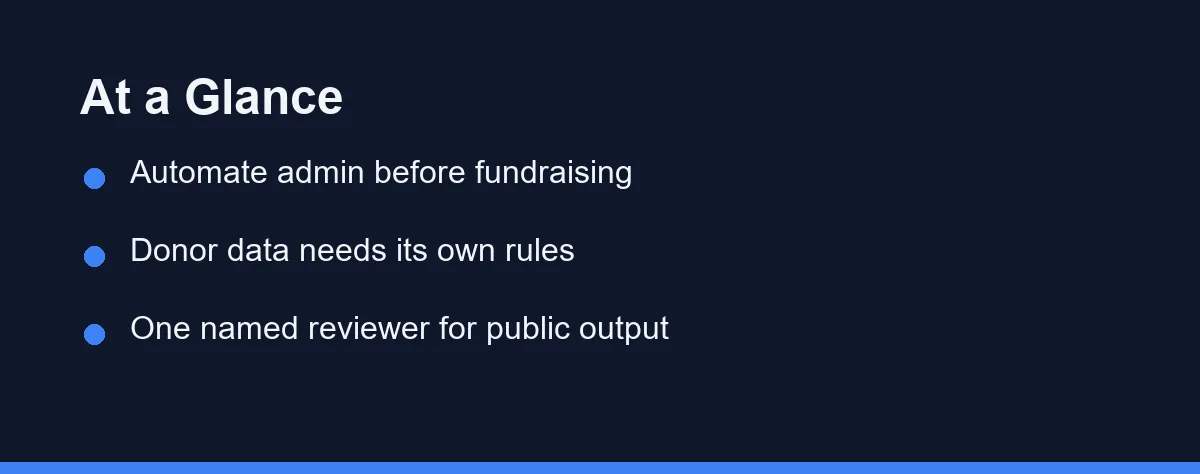
Automate internal admin first. Meeting notes, first drafts of routine communications, summarising long documents, and reformatting content for different channels all carry low risk and immediate payback.
Keep fundraising and grant work under human control. Those documents make claims about your organisation, and every number in them needs verification by someone who knows the programme.
Treat donor data as off-limits until you have read the terms. Privacy obligations do not pause because a tool is convenient, and a breach costs far more than the hours saved.
Start With The Tasks, Not The Tools
The usual failure pattern is backwards. Someone reads about a tool, signs up, and then searches for a use, which ends with three subscriptions and no measurable change.
Spend an hour writing down where last month actually went. Most small nonprofits find the same clusters: communications, reporting, event logistics, volunteer coordination, and funding applications.
Then sort those clusters by two questions. How repetitive is the task, and how much damage does a mistake cause?
Repetitive and low-risk tasks are where tools pay off immediately. Rare and high-stakes tasks are where they belong in a supporting role at most, and that division does more for a small team than any product comparison.
Where AI Earns Its Keep
The table maps common nonprofit tasks to a realistic role for AI. Tool names are examples of the category rather than endorsements, and free nonprofit tiers change often, so confirm the current terms on each official site.
| Task | Realistic role for AI | Where it fails | Example tools |
|---|---|---|---|
| Board and team meeting notes | Transcribe and summarise into actions | Names, jargon, and who agreed to what | Otter, Fireflies, built-in meeting assistants |
| Newsletter and social drafts | First draft and channel reformatting | Local tone, specific beneficiary stories | ChatGPT, Claude, Gemini |
| Long report to short summary | Condensing for board or funder updates | Selecting which findings matter | General chatbots, document summarisers |
| Event graphics and flyers | Layout, resizing, quick variations | Brand consistency without a template | Canva and similar design tools |
| Volunteer scheduling messages | Repetitive confirmations and reminders | Anything involving personal circumstances | Scheduling tools with template automation |
| Grant applications | Structure, outline, tightening prose | Facts, figures, outcomes, eligibility | Human first, tool second |
| Donor records and segmentation | Little, until privacy terms are checked | Data protection obligations | Your CRM, not a general chatbot |
Two rows deserve rereading. The meeting notes row is the fastest win most small teams find, and the grant application row is where enthusiasm causes the most damage.
Notice what the failure column has in common. Every entry involves specific local knowledge, and that is exactly what a general model does not have about your organisation.
Grant Writing Deserves Its Own Rules
Grant applications are the highest-value writing a small nonprofit produces. They are also the documents where a plausible-sounding sentence can be quietly wrong.
Models generate fluent prose regardless of whether the underlying claim is true. A drafted paragraph about programme outcomes will read well and may contain a number nobody can support.
Use the tool where it cannot invent anything. Outlining a response to a published set of questions, tightening a paragraph you wrote, and checking whether an answer addresses what was asked are all safe.
Then verify every factual claim against your own records. Beneficiary numbers, dates, budget lines, and outcome measures come from your systems rather than from a draft.
Check the funder’s own guidance as well. Some funders have begun asking applicants to disclose whether AI assisted the application, and the requirement usually appears in the application notes rather than the headline guidance.
Donor Data Is The Line You Do Not Cross
Donor records carry obligations that a productivity decision cannot override. Names, giving history, contact details, and anything about a beneficiary sit under both data protection law and your own privacy policy.
Pasting that data into a general chatbot is the mistake to avoid. Even where a vendor states that business-tier inputs are excluded from training, your privacy policy may not permit sending the data to a third party at all.
Check three things before any upload. Read the vendor’s data handling page, read your own donor privacy commitment, and confirm whether a nonprofit or business tier changes the terms.
Our explainer on whether a tool trains on your data covers the settings and terms worth reading. When in doubt, work with anonymised or aggregated figures rather than records.
Segmentation and analysis belong in the CRM you already use. Those systems carry contractual protections that a general chatbot does not.
The Discount Programmes Worth Applying For
Budget shapes every decision at this size, and several vendors run nonprofit programmes that change the calculation. Google for Nonprofits offers eligible organisations access to a set of Google products, with details on the official programme page. Its Google Ad Grants programme, for instance, provides $10,000 USD of in-kind search advertising every month for text ads.
Canva runs a nonprofit programme covering its premium tier for eligible organisations. Design work is one of the clearest wins for a small team, since it removes a recurring dependency on a volunteer designer.
Eligibility usually runs through a verification partner and requires registered charitable status. Applications take time, so start them before you need the tools rather than during a campaign.
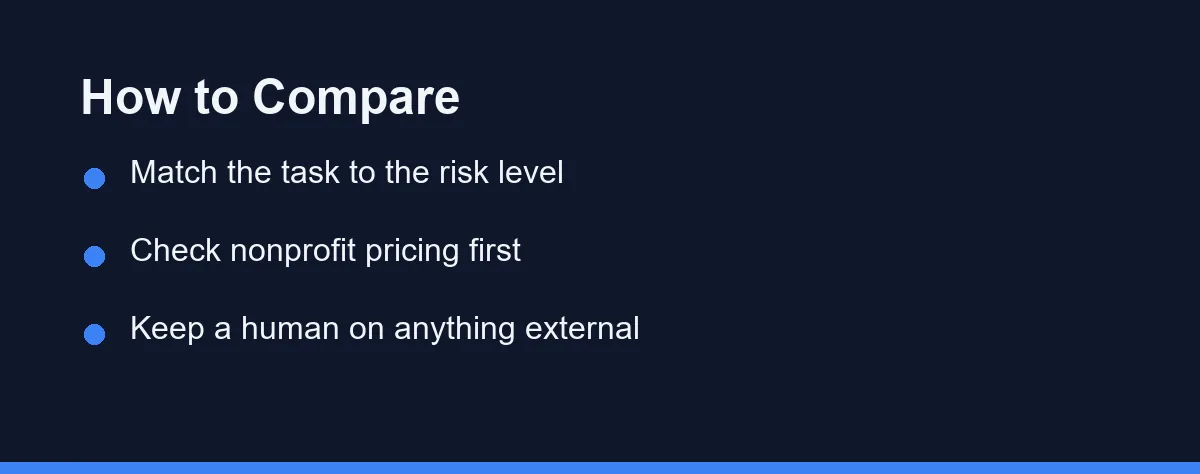
Check the nonprofit pricing page of any tool before paying full price. Discounts are common, inconsistently advertised, and rarely applied automatically.
Terms change, so confirm current eligibility and pricing on each provider’s official site rather than trusting a summary elsewhere.
Which Tool Fits Your Team Size

A single staff member with volunteers: One general assistant and nothing else. A single chatbot handles drafting, summarising, and reformatting, and one subscription is one thing to learn.
Two or three staff with regular board meetings: Add a meeting assistant. Notes and action items are the most repetitive burden at this size, as our roundup of AI meeting assistants sets out. Check free-tier caps first, since Otter’s free Basic plan limits each conversation to 30 minutes and allows 300 transcription minutes a month.
A team producing frequent public communications: Add a design tool with a locked brand template. Consistency, rather than speed, is the thing that breaks first when several people write.
An organisation applying for multiple grants a year: Keep the writing human and use the tool for outlining and editing. A shared document of verified facts saves more time than any generator.
A team with a proofreading bottleneck: A grammar and clarity tool, covered in our comparison of AI grammar checkers. It removes a review step without touching the substance.
Anyone holding sensitive beneficiary data: Slow down and set rules first. Decide what may never leave your systems, write it in one paragraph, and share it with everyone including volunteers.
Common Mistakes To Avoid
Subscribing to several tools at once. A small team can absorb one new habit at a time, and paying for four while using one is a familiar nonprofit budget leak.
Publishing without a named reviewer. Output that nobody owns is where the mistakes reach the public, and a single reviewer for anything external prevents most of it.
Letting the tool write the story. A generated beneficiary story is not a story, and supporters recognise generic writing quickly.
Skipping the nonprofit pricing page. Full price for a tool available free to your organisation is a pure waste of restricted funds.
Assuming volunteers know the rules. Anyone with access to your accounts needs the same one-page guidance as staff.
A Realistic First Month
Pick one task, one tool, and one month. Meeting notes are the usual starting point because the benefit shows up immediately and the risk stays internal.
Write down the rule set before you start. Two lines are enough: what data must never be uploaded, and who reviews anything the public will see.
At the end of the month, ask whether the hours saved reappeared somewhere useful. Time returned to programme delivery is the only measure that matters, and a tool that saves an hour you spend administering the tool has failed.
Then add the second tool, or do not. Many small nonprofits find that one assistant and one meeting tool cover most of the gap. Our broader guide to AI tools for small organisations covers the categories worth considering after that.
Those two lines are the seed of something you will eventually hand to new volunteers. A one-page AI use policy for a small team covers the five decisions worth writing down before the tool list grows.
FAQ
What should a small nonprofit automate with AI first?
Start with writing and admin rather than fundraising. Drafting newsletters, summarising meetings, cleaning up event listings, and turning a long report into a short board update all save hours with low risk. Anything involving donor data or a funder's application deserves stricter rules.
Is it acceptable to use AI for grant applications?
Use it for structure and early drafts, not for the final submission. A grant application is a claim about your organisation, and every figure and outcome has to be verified by a person who knows the programme. Check each funder's guidance, since some now ask applicants to disclose AI use.
Can you put donor information into an AI tool?
Not without checking the terms first. Donor records usually carry privacy obligations, and pasting them into a general chatbot can breach both your privacy policy and the platform's terms. Review the vendor's data handling page and your own donor privacy commitments before any upload.
Are there free AI tools for registered nonprofits?
Several vendors run nonprofit programmes with free or discounted tiers, and Google for Nonprofits and Canva's nonprofit programme are among the better known. Eligibility usually requires registered charitable status and verification through a partner service. Confirm current terms on each provider's official page.
How do you stop AI content from embarrassing the organisation?
Assign one person as the reviewer for anything the public will see. Small teams fail here not through bad intent but through nobody owning the final read, and a named reviewer solves most quality and accuracy problems at once.
Sources
- Google for Nonprofits: Google Ad Grants — checked 2026-09-27
- Otter.ai: Pricing — checked 2026-09-27
Some links may be affiliate links. We may earn a commission at no extra cost to you.
This article was written with AI assistance. It is researched and fact-checked, not based on personal hands-on testing unless explicitly stated.
Comments
Post a Comment