The Question That Arrives After the Work Is Done
Most people ask this question late. The logo already exists, the article is scheduled, and a client has asked who owns the file.
The answer is less alarming than it first sounds, and less generous than tool marketing implies. Copyright law in the United States protects human authorship, and a generator is not a human author.
That single principle explains almost every ruling and guidance document published so far. It also explains why two creators using the same tool can end up with very different rights.
What follows separates the parts of a workflow that you own from the parts that nobody does. It is general information rather than legal advice, so confirm the specifics with a qualified lawyer before anything expensive depends on the answer.
The Short Version for Working Creators
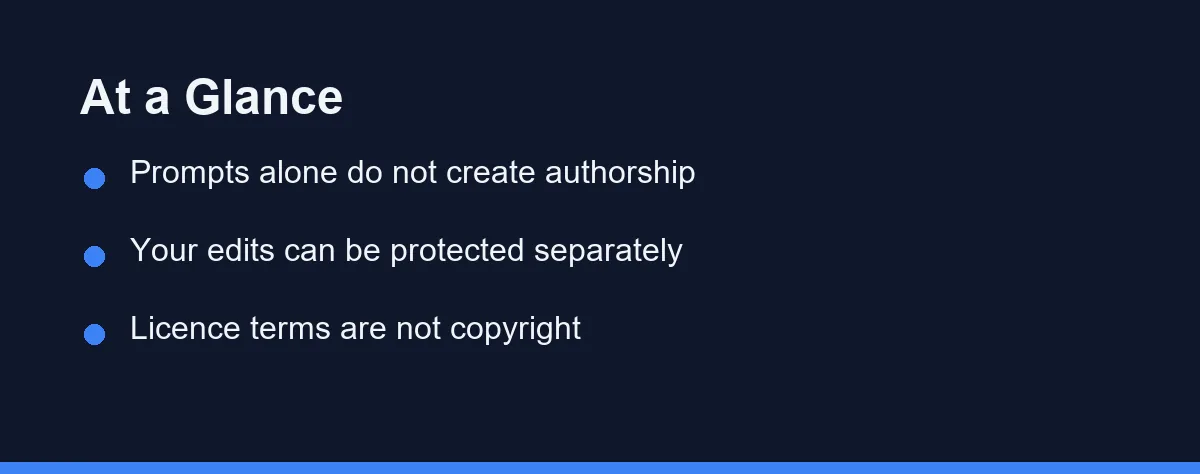
Output generated from a prompt alone is not protectable in the United States. Prompts are treated as instructions rather than authorship, however detailed they are.
Your own contribution remains protectable. Editing, arranging, compositing, and writing around the generated material all create expression that belongs to you.
Registration is where the distinction becomes concrete. The Copyright Office asks applicants to disclaim generative output and describe the human contribution, so the paperwork forces you to draw the line yourself. As of September 2026, the Office’s fee schedule lists $45 for an online Single Application and $65 for a Standard Application.
Why Human Authorship Is the Whole Test
United States copyright has long required a human author, and courts have applied that requirement to non-human creators before generative tools existed. The 2023 registration guidance and the Office’s subsequent report on copyrightability applied the same rule to AI output.
The federal courts reached the same place in the Thaler litigation, where a work listing an AI system as the author was refused registration. The refusal turned on authorship rather than on the quality of the work.
Prompting sits on the wrong side of that line. However carefully you engineer a prompt, the Office’s position as of 2026 is that the tool determines the expressive details rather than you.
The practical consequence is narrow but real. Anyone can copy purely generated output without infringing your copyright, because there is no copyright to infringe.
What You Still Own
Selection and arrangement carry more weight than most creators expect. A comic assembled from generated panels was registered for its text and its arrangement while the individual images sat outside the protection.
Substantial editing produces the same result. When a generated draft becomes a scaffold that you rewrite, restructure, and extend, the finished work reflects your choices and your expression.
Composite work behaves similarly. Generated elements placed into a design you authored, alongside your own photography, typography, and layout, leave a protectable whole around unprotectable parts.
Your source material also stays yours. A script you wrote and then had narrated by a synthetic voice remains your script, which is worth remembering when comparing tools in our guide to AI writing tools.
Seven Real Workflows and Where They Land
The table walks through the workflows that come up most often, and where each one sits under current United States guidance.
| Workflow | Human contribution | Protectable in the US | Practical risk | What to keep |
|---|---|---|---|---|
| Text generated from a prompt, published as-is | Prompt only | No | Anyone may copy it freely | Nothing useful |
| AI draft rewritten and restructured by you | Substantial rewriting | Yes, for your expression | Low if edits are real | Draft history and revisions |
| Image generated and used unchanged | Prompt only | No | High for logos and mascots | Generation records |
| Generated image composited into your design | Layout, edits, additions | Yes, for your contribution | Moderate | Layered source files |
| Comic or book combining generated art with your text | Text plus arrangement | Yes, text and arrangement | Moderate | Manuscript and layout files |
| Your script read by a synthetic voice | The script itself | Yes, the script | Low | Script and voice licence |
| Code generated from your detailed specification | Specification and integration | Contested, fact dependent | Moderate for core assets | Commit history and specs |
Two rows deserve extra attention. Unchanged generated images used as brand assets carry the most exposure, because a competitor could adopt something visually identical without infringing anything.
The code row remains genuinely unsettled. Treat generated code as usable but not as a defensible moat, and keep the commit history that shows your own contribution.
Licence Terms Are Not Ownership
Vendor terms of service confuse this constantly. Several major image and text tools assign you whatever rights they hold in the output, and creators read that as ownership.
It is not the same thing. A licence tells you what the vendor will permit, while copyright determines what the law will protect against third parties.
Both can be true at once. You may hold broad commercial rights from the vendor and still hold no copyright in the output, which means you can sell it while nobody can be stopped from copying it.
Read the terms for the other half too. Some plans restrict commercial use on free tiers, and our comparison of AI image generators covers where those tiers differ.
The International Picture Is Not Uniform
The United Kingdom has a statutory provision for computer-generated works with no human author, which grants a shorter term to the person who made the arrangements. Section 12(7) of the Copyright, Designs and Patents Act 1988 ends that protection 50 years after the end of the year the work was made. It predates generative AI by decades and its application to modern tools is debated.
Chinese courts have taken a case-by-case approach, and at least one decision granted protection to an AI-assisted image where the user made numerous adjustments. That reasoning differs meaningfully from the American position.
Most other major markets currently sit closer to the American view, requiring human creativity for protection. The direction of travel varies, and legislation is under discussion in several places.
If you publish across borders, the practical answer is to build human authorship into the work rather than to rely on any one jurisdiction. A work with real human expression is defensible almost everywhere.
Who Should Worry About This and Who Should Not
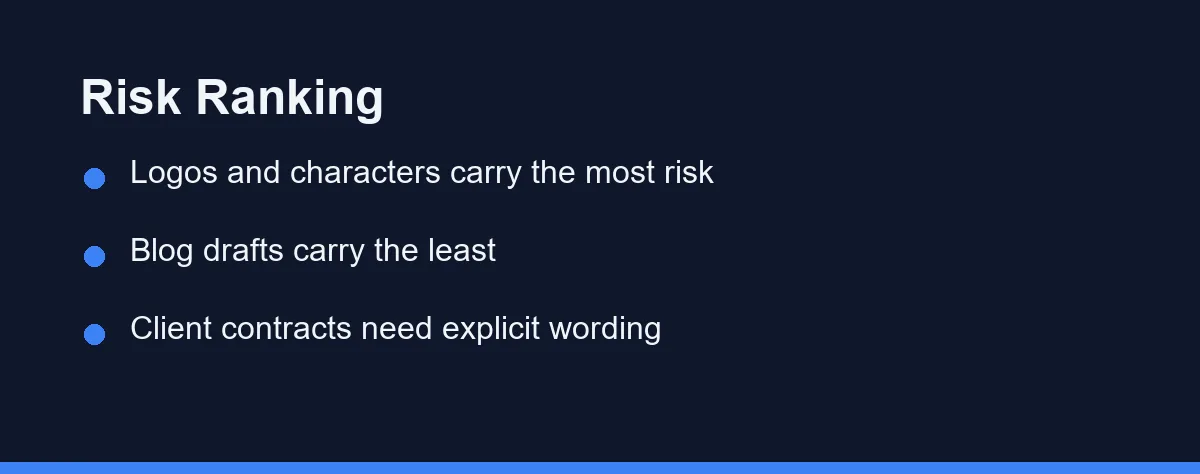
A blogger illustrating posts with generated images: Low concern. Nobody is likely to copy your header art, and the article text you wrote is protected on its own.
A founder using a generated logo: High concern. Trademark can still protect a mark in use, but copyright will not stop a competitor from using a near-identical generated image. Commission or substantially redraw anything that carries brand identity.
A freelancer delivering work to clients: Address it in the contract. Say what tools were used and what you are transferring, because a client who assumes full copyright and later learns otherwise has a real complaint.
An author writing a book with AI assistance: Manageable, with records. Keep drafts that show your writing process, and disclaim generated passages when you register.
A game or app studio shipping generated assets: Treat the assets as replaceable. Anything central to the product’s identity deserves human authorship, and peripheral assets can stay generated.
A student or researcher: Copyright is rarely the binding constraint. Institutional disclosure rules and academic integrity policies matter more, and our piece on what proves you wrote it covers that ground.
What to Record While You Work
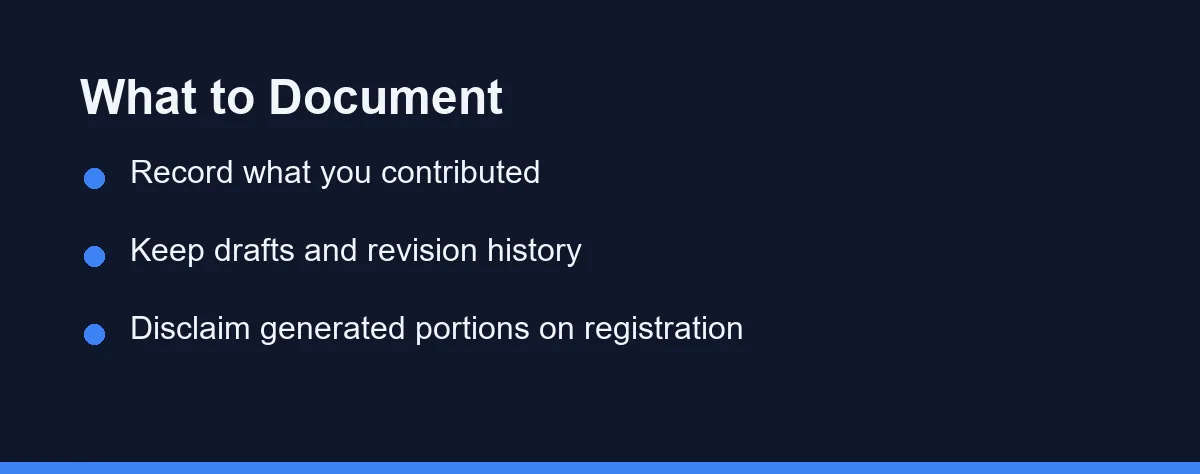
Documentation is the cheapest protection available, and almost nobody does it. Start with revision history, since a document that shows real editing over time is far more persuasive than a finished file.
Keep the generated originals separately from your edited versions. The comparison between them is the clearest evidence of what you contributed.
Note which tool produced what, and when. Registration asks for this, and reconstructing it a year later from memory is unpleasant.
Finally, write the disclosure into your client agreements now rather than after a dispute. A short clause naming the tools and the transferred rights costs nothing and prevents the common misunderstanding.
Where This Leaves a Practical Workflow
Use generative tools for drafts, exploration, and volume, and keep human judgment at the points where ownership matters. That split follows the law rather than fighting it.
Reserve human authorship for the assets you would hate to lose: brand marks, signature characters, and anything a competitor could adopt wholesale. Generated material is fine everywhere else.
Check the current position before making a decision with money attached, since guidance in this area moves. The Copyright Office publishes its registration guidance and reports at copyright.gov, and reading the source beats relying on a summary.
One habit covers most of the risk. Ask what a competitor could legally copy from your work tomorrow, and if the answer is uncomfortable, put more of yourself into the file before publishing.
Self-published authors meet this question in a very concrete form when they upload a cover. Our walkthrough of using an AI-generated cover on Amazon KDP shows how the ownership gap interacts with the disclosure Amazon requires.
Freelancers face the same gap from the other side of a contract, because a client usually expects full copyright in what they pay for. Our guide on whether a freelancer can hand a client AI-generated work covers how to word the assignment and warranty so you do not promise rights that may not exist.
Logos are the place where this gap surprises business owners most, because a brand mark needs protection more than almost any other image. Trademark registration works on different rules from copyright, and our guide to whether you can trademark an AI-generated logo explains the USPTO fees and the specimen problem.
FAQ
Can you copyright an image made entirely by an AI generator?
In the United States, no. The Copyright Office has repeatedly held that copyright protects human authorship, and output produced from a prompt alone does not qualify. Your own edits, selection, and arrangement can be protected separately.
Is an AI draft that you heavily rewrote protectable?
Usually yes, provided the human contribution is substantial rather than cosmetic. Rewriting, restructuring, and adding original material create protectable expression. Changing a few words in a generated draft does not.
Do you have to tell the Copyright Office that you used AI?
Registration asks you to disclaim material that a generative tool produced. Describe what you contributed and exclude the machine-generated portions, rather than staying silent about the tool.
Does the tool's terms of service give me copyright?
Not automatically. A vendor can grant you broad commercial rights in its terms while the output still fails the human-authorship test. Commercial permission and copyright ownership are two separate questions.
Are the rules the same outside the United States?
Rules differ by country, and a few jurisdictions have provisions for computer-generated works that the United States lacks. If you publish internationally, check the position in each market that matters to you.
Sources
- U.S. Copyright Office: Fees — checked 2026-09-27
- legislation.gov.uk: Copyright, Designs and Patents Act 1988, section 12 — checked 2026-09-27
Some links may be affiliate links. We may earn a commission at no extra cost to you.
This article was written with AI assistance. It is researched and fact-checked, not based on personal hands-on testing unless explicitly stated.
Comments
Post a Comment