
Two Different Questions People Ask as One
The short answer is yes, with conditions. Use a paid plan, read its commercial-use clause, and keep brands and recognisable faces out of the image, and most small-business use is covered. Ownership is the weaker part, since a raw generation may protect nothing.
A designer generates a hero image in thirty seconds, drops it on a client’s landing page, and then a doubt arrives. Is this allowed.
The doubt usually mixes two questions that have different answers. One is whether you have permission to use the image commercially. The other is whether you own it in the way you own a photograph you took.
Permission comes from the tool’s terms. Ownership comes from copyright law, which has been unusually clear about machine-generated material and unusually unhelpful about the middle ground.
This guide separates the two, then adds the third layer that trips people up most often, which is the rules of wherever the image ends up. None of this is legal advice, and anything with real money attached deserves a lawyer.
Paid Plans Cover the Easy Part
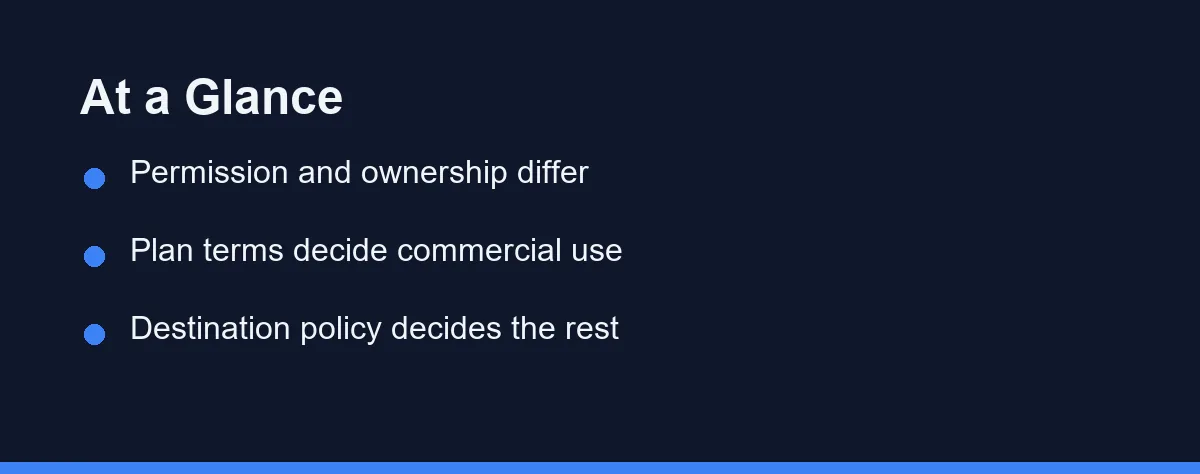
Most paid plans from the major image tools permit commercial use of what you generate. That is a contract between you and the provider, and it is usually the easy part.
Copyright is different. The US Copyright Office has repeatedly held that purely machine-generated output lacks the human authorship protection requires, so a raw generation may sit outside copyright entirely.
The practical risk rarely comes from either. It comes from what the image contains, such as a trademark, a recognizable person, or a style close enough to a living artist’s work to invite a complaint.
Ownership Versus Permission
These two ideas get flattened into “can I use this,” and keeping them apart makes every other decision easier.
Permission is contractual. When a provider says paid users may use outputs commercially, that promise binds the provider, and it is enforceable in the ordinary way.
Ownership is statutory. Copyright arises from human creative authorship, and no contract clause can manufacture protection where the law grants none.
The gap between them has a specific consequence. You may be perfectly entitled to publish an image while having no legal ground to stop a competitor from reposting the same generation.
What the Copyright Office Has Actually Said
The clearest early example is the graphic novel Zarya of the Dawn. The Copyright Office registered the author’s text and arrangement, then refused protection for the Midjourney images inside it.
Later guidance kept the same line. Prompting alone, however detailed, has not been treated as enough authorship, since the applicant does not control the expressive result the way a photographer controls a photograph.
Human contribution can still earn protection. Selection, arrangement, substantial editing, and combination with your own work create a protectable layer over unprotected material, which is how most real projects actually look.
The agency publishes its current position and registration guidance at copyright.gov, and the area keeps moving through the courts. Treat any summary, including this one, as a snapshot as of 2026.
What the Platform Terms Control
Terms differ far more than the marketing suggests, and they differ by plan within the same product.
Free and trial tiers are the common trap. Several tools reserve commercial rights for paying customers, and some grant themselves a broad license to display what free users generate.
Training provenance is the other axis. Tools trained on licensed or owned libraries market that fact heavily, because it lowers the odds that an output resembles someone else’s protected work.
Indemnification sits at the top end. Where a provider offers it, the company agrees to defend qualifying claims, usually on business or enterprise plans and usually with conditions about how you used the tool.
Where the Major Tools Stand

Terms change often, so treat this as a map of what to look for rather than a current quote. Confirm every row on the provider’s own terms page before relying on it.
| Tool | Commercial use | Training data posture | Indemnification | Watch for |
|---|---|---|---|---|
| Adobe Firefly | Allowed on paid plans | Licensed and owned sources, marketed as commercially safe | Offered on business tiers | Feature-by-feature differences |
| Midjourney | Allowed for subscribers | Broad web training, disclosed in terms | Not a standard consumer feature | Public gallery defaults, revenue thresholds |
| OpenAI image generation | Allowed under the usage terms | Broad training, details limited | Enterprise agreements vary | Content policy restrictions |
| Google Gemini image tools | Allowed per current terms | Broad training with provenance marking | Enterprise agreements vary | Regional availability differences |
| Stable Diffusion, self-hosted | Depends on the model license | Model-specific, varies by checkpoint | None by default | License of the exact checkpoint |
| Canva AI | Allowed within Canva’s terms | Mixed sources | Limited | Restrictions on resale of templates |
The last column matters more than the first. Almost every tool permits commercial use somewhere in its lineup, so the differences that bite live in the exceptions.
The Risks That Have Nothing to Do With Copyright
A generation can be fully permitted and still cause a problem, because other bodies of law apply to the image’s contents.
Trademarks are the most common. A logo, a distinctive product shape, or a brand’s trade dress appearing in your marketing creates exposure whatever tool produced the picture.
The reverse case trips up new businesses too. If the AI image is meant to become your own logo, the question shifts from infringement to whether you can register it, which we cover in whether you can trademark an AI-generated logo.
Likeness is the second. Many jurisdictions recognize a right of publicity, so a face that resembles a real person in a commercial context invites a claim regardless of how the pixels arrived.
Deceptive advertising is the third and the most underrated. Consumer protection rules apply to what an ad implies, so an AI image showing a product feature that does not exist is a problem in the same way a doctored photograph would be.
Where the Image Is Going Matters
The destination often has stricter rules than either the tool or the law, and its rules are the ones that get enforced against you quickly.
Stock libraries vary sharply. Some accept AI submissions with disclosure, others refuse them, and the policies have changed more than once in recent years.
Marketplaces increasingly ask for disclosure. Book publishing platforms and craft marketplaces have added AI questions to their listing flows, and misreporting there risks the account rather than a lawsuit.
Print and packaging carry a quieter risk. Resolution and artifacts that pass on a screen become obvious at print size, and a supplier may reject the file after you have committed to a deadline.
Regulatory transparency rules are also arriving. Obligations around labeling synthetic content are phasing in across jurisdictions, so check the current requirements for the markets you sell into.
Which Approach Fits Your Use

Risk scales with visibility and with how much money rides on the image. Match your process to that, not to a blanket rule.
Blog headers and social posts: generate freely on a paid plan. Exposure is low, the images are decorative, and no one is relying on them to make a purchase decision.
Paid advertising creative: be careful with anything depicting the product itself. Use AI for backgrounds, abstract elements, and layout, and use real photography for what the customer is buying.
Client work you deliver as a deliverable: disclose your use in writing and check the client’s own policy first. Agencies increasingly have clauses about this, and finding out afterwards is the expensive path.
Anything you plan to license or resell: prefer a tool with clear commercial terms and a licensed training corpus, and add substantial human editing so a protectable layer exists. Registering that layer online costs $65 with the Copyright Office’s Standard Application, or $45 for a single author filing one work, as of September 2026.
Regulated industries such as finance or health: treat AI imagery as you would any other claim-bearing asset. Indemnified enterprise tooling exists for exactly this reason.
Book covers, merchandise, and packaging: check the marketplace’s disclosure policy before you design, since a rejected listing after a print run is a costly way to learn the rule.
Mistakes That Create Real Exposure
Four errors account for most trouble, and none of them require a courtroom to hurt.
Generating on a free tier and shipping the result to a client is the first. The permission you needed lived one plan up, and the terms page said so.
Prompting with a living artist’s name is the second. The output may be lawful, and the reputational damage when someone recognizes the style is a separate cost.
Keeping no records is the third. Save the tool, plan, date, and prompt for anything commercial, because reconstructing that trail a year later is close to impossible.
Assuming the tool’s permission covers the destination is the fourth. Marketplace and platform rules operate independently, and they act faster than any legal system. Our AI image generator comparison covers which tools suit which output, and the Midjourney and DALL-E breakdown goes deeper on how the major models differ.
The Last Word
The honest answer to the headline question is yes, with conditions that depend less on the law than most people expect.
Use a paid plan, read the clause about commercial use, and keep the image free of brands and recognizable faces. That handles the overwhelming majority of small-business use.
Then check where the image is going, because the marketplace or ad platform will enforce its rules long before anyone else does.
Ownership is the part to stay realistic about. A raw generation may protect nothing, so if an image needs to be defensibly yours, your own work has to be visible in the final result.
Disclosure is a separate question from licensing, and some generators now attach a signed record of origin to the file itself. Our explainer on what Content Credentials mean on an AI image covers what that record proves and how little of it survives an upload.
If the image is going to a client rather than your own business, the contract matters as much as the platform terms. Our walkthrough of handing a client AI-generated work explains the Midjourney revenue rule for client companies and the clauses worth rewriting.
FAQ
Can I use AI-generated images in my business?
In most cases yes, as long as your plan permits commercial use and the image does not copy a protected work, brand, or person. The harder question is whether you own the result, which is a separate issue from whether you may use it.
Can you copyright an AI-generated image?
The US Copyright Office has taken the position that material generated purely by a machine lacks the human authorship copyright requires. Your own creative arrangement, edits, and text can still qualify, so a finished design is rarely all-or-nothing.
Does the free plan of an AI image tool allow commercial use?
Free tiers frequently grant narrower rights than paid plans, and some reserve the images for non-commercial use or allow the provider to display them publicly. Read the plan page rather than the marketing page before using anything for work.
What does it mean when a provider offers indemnification?
Indemnification means the provider agrees to defend you if a third party claims the output infringes their rights. Several enterprise plans offer it with conditions attached, which is why regulated and large-brand work often lands there.
Do I have to disclose that an image is AI-generated?
Platform by platform. Some marketplaces require disclosure, some stock libraries refuse AI submissions outright, and advertising rules still forbid misleading images however you produced them. Check the destination's policy, not just the tool's.
Sources
- U.S. Copyright Office: Fees — checked 2026-09-27
Some links may be affiliate links. We may earn a commission at no extra cost to you.
This article was written with AI assistance. It is researched and fact-checked, not based on personal hands-on testing unless explicitly stated.
Comments
Post a Comment