Three Different Personalities, One Prompt Box
Three tools keep coming up whenever people talk about AI images: Midjourney, DALL-E, and Stable Diffusion. They can all turn a sentence into a picture. How they get there could not be more different.
Midjourney feels like a stylish art studio. DALL-E feels like chatting with a helpful assistant. Stable Diffusion feels like an open workshop full of dials and custom parts.
That difference in personality is the whole decision. This guide compares the three on the things that change your day: style, ease of use, control, cost, and licensing.
The aim is a clear, honest read you can act on, not a push toward any single product.
Polish, Ease, or Control

If you want the most polished, artistic results with minimal effort, Midjourney is a strong default. Its outputs often look refined straight out of the box. It suits creative and marketing imagery.
If you value simplicity and tight integration with chat assistants, DALL-E is the easiest entry point. It accepts natural language and works well for quick concepts. It is ideal for non-technical users.
If you need maximum control, customization, or local generation, Stable Diffusion stands out. It is open and highly flexible. It rewards users who want to fine-tune every detail.
Four Factors That Change Your Day
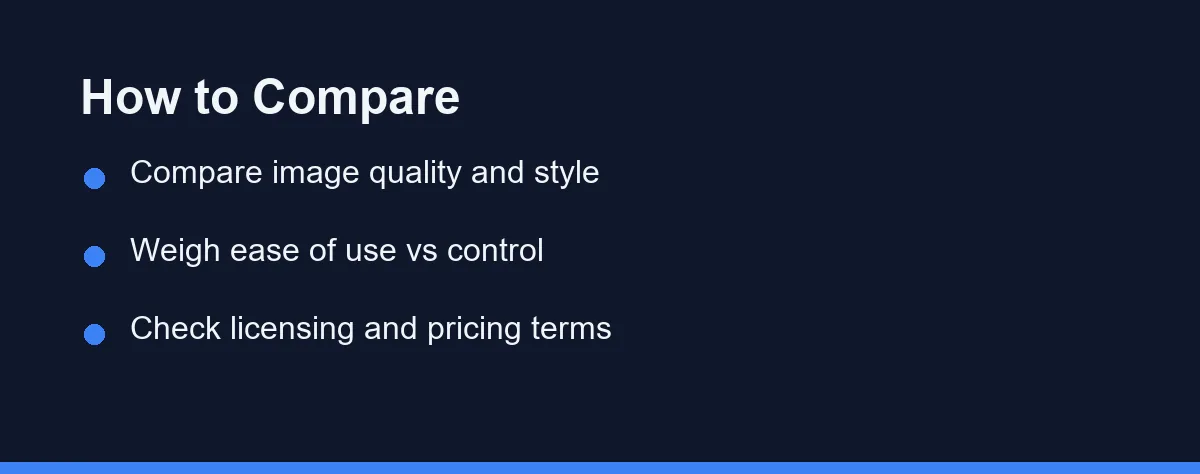
Before comparing tools, decide which factors matter most to you. Different projects demand different strengths. A clear list of priorities makes the choice far easier.
Image quality and style is the most visible factor. Some tools lean toward stylized art, while others aim for realism. Look at sample galleries to judge the default aesthetic.
Ease of use determines how fast you can get results. Chat-based tools require no setup, while local tools need installation. Consider your comfort with technical steps.
Control and customization affect how precisely you can shape an output. Features like fine-tuning, model swapping, and negative prompts add power. These matter most for repeatable, branded work.
Access and cost shape long-term fit. Some tools are cloud subscriptions, while others can run on your own hardware. Licensing for commercial use also varies and should be verified.
An Art Studio, an Assistant, a Workshop
The three leading options each serve a distinct type of user. Below is a short summary of where each one fits. Many creators end up using more than one over time.
Midjourney
Midjourney is known for producing visually striking, stylized images. It has historically been accessed through a community-driven interface and a web app. Its results often need little editing to look professional.
The platform favors aesthetic quality and coherent composition. It is popular among artists, marketers, and concept designers. For broader category context, see our best AI image generators roundup.
DALL-E
DALL-E is built around plain natural-language prompts. It is commonly available inside chat assistants and creative apps. This makes it one of the most accessible options for newcomers.
It handles everyday concepts and quick mockups well. It also integrates smoothly with text-based workflows. Users who already rely on AI assistants will find it familiar.
Stable Diffusion
Stable Diffusion is an open model family that prioritizes flexibility. It can run locally or through many hosted services. This openness has created a large ecosystem of add-ons and custom models.
It is the most customizable of the three. Power users can fine-tune models for specific styles or subjects. The tradeoff is a steeper learning curve and hardware considerations.
Style, Access, and Customization Lined Up
The table below compares the three tools on practical criteria. Use it as a starting point rather than a final verdict. Your own priorities should guide the final decision.
| Criteria | Midjourney | DALL-E | Stable Diffusion |
|---|---|---|---|
| Default style | Artistic, polished | Versatile, literal | Depends on model |
| Ease of use | Moderate | Very easy | Advanced |
| Control / customization | Limited | Limited | Extensive |
| Access | Cloud / web | Cloud / chat apps | Local or cloud |
| Best for | Creative visuals | Quick concepts | Custom workflows |
| Learning curve | Low to moderate | Low | High |
| Prompt style | Keyword and natural | Plain natural language | Detailed, with negatives |
| Local / offline use | No | No | Yes, with a GPU |
| Ecosystem and add-ons | Growing web tools | Tied to chat apps | Huge open ecosystem |
Midjourney and DALL-E favor speed and convenience. Stable Diffusion trades some convenience for deep control. The right balance depends on your skills and goals.
Match the Tool to the Task

Start by naming your main use case. A marketer making social graphics has different needs than a developer building a pipeline. Matching the tool to the task avoids wasted effort.
If you want results with the least friction, choose a cloud option. Midjourney and DALL-E both remove setup from the equation. They are best when speed matters more than fine control.
If you need repeatable, branded, or highly specific output, lean toward Stable Diffusion. Its customization can produce consistent styles across many images. This suits teams with technical capacity.
Also weigh your hardware and budget. Local generation can reduce per-image cost but requires a capable machine. Try free tiers or trials before committing, and compare with the best free AI tools for budget-conscious starting points.
For broader tool decisions beyond images, our guide to the best AI writing tools covers a related category. Pairing an image tool with a writing tool often improves overall content workflows. Many creators build a small stack rather than relying on one app.
Cloud Subscriptions Versus Your Own GPU
Pricing for these tools changes frequently, so treat any figure as temporary. Plans, tiers, and free allowances are all subject to revision. Always confirm the latest details on each official site.
The table below shows approximate pricing tiers at the time of writing. Confirm current pricing on each official site, since plans change often.
| Tool | Free tier | Individual paid | Team / business |
|---|---|---|---|
| Midjourney | Limited or none | Basic around $10/mo | Pro and Mega tiers |
| DALL-E | Limited free access | Bundled in ChatGPT Plus (~$20/mo) | Team and Enterprise per seat |
| Stable Diffusion | Free to run locally | Hosted plans vary | Hosted or self-managed |
In general, Midjourney and DALL-E are offered as paid cloud services with tiered plans. Some access may be bundled into broader subscriptions. The exact structure varies by provider and region.
Stable Diffusion models are open and can be run locally without per-image charges. However, hosted Stable Diffusion services and certain model versions may carry their own costs or terms. Hardware and electricity are real costs to factor in for local use.
Before subscribing, review commercial-use rights for your intended projects. Licensing terms differ across the three and can affect business use. The official Midjourney, OpenAI DALL-E, and Stability AI sites are the authoritative sources.
Getting the Best Results From Each Tool
Each of these tools rewards a slightly different prompting habit. A little adjustment goes a long way.
With Midjourney, describe mood, lighting, and art style, then adjust aspect ratio and stylize settings. It responds well to evocative, visual language.
With DALL-E, write in plain, complete sentences and iterate through follow-up messages. Conversational refinement is its strength, so treat it like a dialogue.
With Stable Diffusion, use both positive and negative prompts, and try different base models for a style. Negative prompts remove unwanted elements, which sharpens the final result.
Across all three, generate several options before committing. The first image is rarely the best one, so batch and pick. If your image needs readable words on it, plan a separate typography pass, because AI image generators still get text wrong regardless of which tool you pick.
Prompt Habits That Waste Time
A few habits waste time with any image generator. Steering clear of them improves results fast.
Do not overload a single prompt with every idea at once. Build the image in steps instead, refining one aspect at a time.
Do not ignore licensing before commercial use. Rights differ across the three tools and change over time, so confirm terms on the official site.
Do not judge a tool from one weak result. Try several prompts and settings before deciding it does not fit your work.
Which Model Fits Your Art Style
Best for beginners: DALL-E is the easiest on-ramp. You type a plain description inside a chat interface and refine from there. There is no setup and no special prompt syntax to learn.
Best for artistic and marketing visuals: Midjourney delivers polished, stylized images with little effort. Its default look suits concept art, posters, and social content. Most results appear finished straight away.
Best for full control and custom styles: Stable Diffusion is the clear pick. You can run it locally, swap models, and use negative prompts for precise output. It rewards users who want repeatable, branded results.
Best for budget and volume: Local Stable Diffusion avoids per-image fees once your hardware is set up. That suits heavy batch generation. Factor in the cost of a capable GPU and the time to learn it.
Best for a simple cloud workflow: Midjourney and DALL-E both skip installation entirely. They fit anyone who wants results without managing hardware. Pick Midjourney for style and DALL-E for plain-language ease.
Each Owns a Different Corner
The Midjourney versus DALL-E versus Stable Diffusion debate has no universal winner. Each one owns a different corner. Midjourney takes polish, DALL-E takes ease, and Stable Diffusion takes control.
So flip the question around. Do you want the prettiest result, the simplest path, or the deepest control? Your honest answer points straight at one of the three.
Test the option that fits your use case before you pay, and check the licensing for any commercial work. Many creators end up keeping two of them for different jobs, and that is a perfectly good outcome.
FAQ
Which AI image generator is best for beginners in 2026?
DALL-E tends to be the most beginner-friendly because it uses plain text prompts inside familiar chat interfaces. Midjourney is also approachable once you learn its prompt style. Stable Diffusion offers more control but has a steeper learning curve.
Is Stable Diffusion free to use?
The Stable Diffusion models are open and can be run locally without per-image fees if you have suitable hardware. Hosted services and some newer model versions may have their own terms. Always confirm current licensing and pricing on the official site.
Can these tools be used for commercial work?
Each platform has its own commercial-use terms that change over time. Midjourney, DALL-E, and Stable Diffusion all address commercial rights differently depending on your plan. Check the official site of each tool for the latest licensing details.
Which produces the most realistic images?
Midjourney is often preferred for photorealistic and richly stylized results out of the box. Stable Diffusion can match or exceed it with the right model and tuning. DALL-E is close and easiest to prompt for quick realistic scenes.
Do I need a powerful computer to use these tools?
Only for local use. Stable Diffusion runs best on a computer with a capable GPU and enough video memory. Midjourney and DALL-E run in the cloud, so a basic laptop is enough for them.
Sources
- Stability AI License — checked 2026-09-27
Some links may be affiliate links. We may earn a commission at no extra cost to you.
This article was written with AI assistance. It is researched and fact-checked, not based on personal hands-on testing unless explicitly stated.
Comments
Post a Comment