
The Draft Reads Clean, and That Is the Problem
Treat every claim in an AI draft as unverified until you trace it to a primary source. If you publish the piece, run a claim-by-claim pass rather than a reread, because fluent errors survive editing. An internal memo usually needs only a spot-check, while health, money, and legal content needs a qualified human reviewer as well.
An AI draft arrives polished, structured, and confident, which is exactly what makes it dangerous. Human errors tend to look like errors, while model errors wear the same fluent tone as everything around them.
The failure is quiet by design. A wrong statistic sits in a grammatical sentence, a fabricated study carries a plausible author, and nothing on the page signals which sentences are load-bearing fiction. Vectara’s public leaderboard, which measures how often a model introduces hallucinations when summarizing a document, listed 1.8% for the best-scoring model and 9.6% for GPT-4o as of September 2026.
Editing does not catch this, because editing evaluates prose. Fact-checking is a different activity with a different unit of work, which is the claim rather than the sentence.
This guide turns that activity into a repeatable workflow. Extract the claims, rank them by damage, trace each to an independent source, and give numbers and quotes their own pass.
Start by Extracting Every Checkable Claim
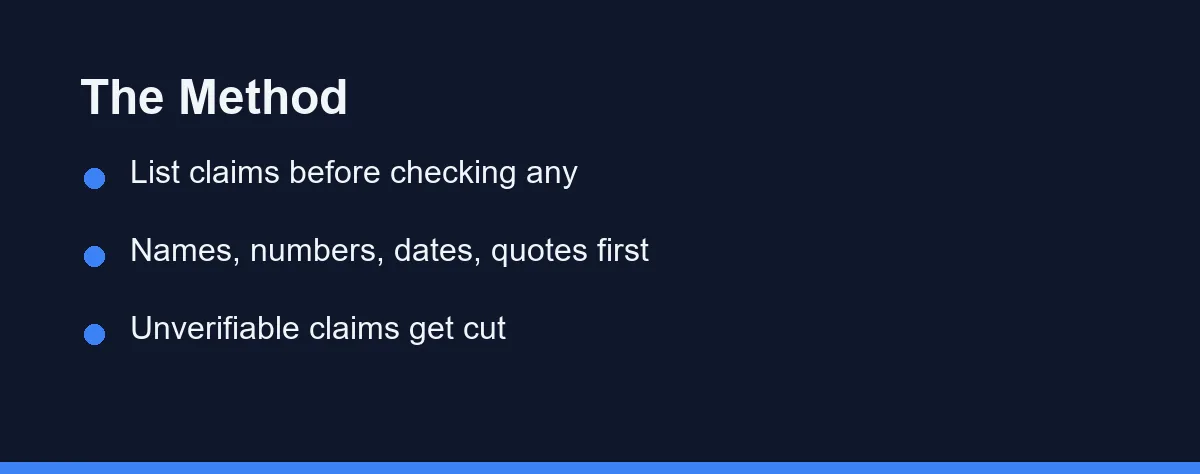
Read the draft once with a single question in mind, which is what would have to be true for this sentence to stand. Every name, number, date, quote, ranking, and cause-and-effect statement goes onto a list.
Be mechanical about it rather than trusting your sense of what feels risky. The claims that burn publishers are usually the ones that felt too obvious to check.
A typical thousand-word draft yields fifteen to thirty checkable claims. Seeing them as a list changes the job from rereading an article to clearing a queue, and queues get finished.
Chat models are genuinely useful at this step. Pasting the draft and asking for every factual claim as a bullet list works well, because extraction is a reading task rather than a knowledge task.
Sort Claims by Damage, Not by Order of Appearance
Not all claims deserve equal effort, and checking them in page order spends your attention randomly. Rank the list by what happens if the claim is wrong.
Top priority goes to anything touching health, money, law, or safety, plus every named person and company. A wrong dosage or a false statement about a real business causes harm and liability, not just embarrassment.
Second priority covers the load-bearing facts, meaning the statistic in the headline and the study the argument rests on. If one of these fails, the piece fails with it.
The bottom tier holds background claims that are widely documented and low-stakes. These get a quick confirmation, and the hours go to the top of the list.
Trace Each Claim to a Source That Existed First
The core rule of the whole workflow fits in one sentence. Every claim must trace to a source that existed before the draft did, and the draft itself can never be its own evidence.
Go to primary sources wherever they exist. The agency report beats the article about the report, the company pricing page beats a roundup, and the study beats the press release describing it.
Fabricated citations collapse fast under this rule, because the first click finds nothing. Search-connected tools make locating primaries faster, and our Perplexity versus ChatGPT comparison covers how retrieval-first tools surface documents plain chatbots paraphrase.
When no source can be found, the claim does not get the benefit of the doubt. It gets cut, reworded into something supportable, or explicitly framed as opinion.
Numbers, Dates, and Names Deserve a Second Pass
Even after sourcing, run a dedicated pass over every figure, because numbers fail in ways prose does not. Models round aggressively, swap years, mix currencies, and blend two real statistics into one invented hybrid.
Check each number against its source three ways. The value must match, the unit and timeframe must match, and the population must match, since seventy percent of US adults is not seventy percent of everyone.
Dates and names get the same treatment. Confirm spellings, titles, and whether the person still holds the role the draft assigns them, because models freeze people in their training data.
Prices and policies are the perishable class. Anything involving what a product costs or allows should carry a confirmation habit tied to the official site as of 2026, and a recheck before any republication.
Quotes and Citations Are Where Models Fail Silently
Treat every quotation in an AI draft as unverified until you find it verbatim in a primary source. Models assemble quote-shaped sentences from paraphrase, and attach them to real people who said something adjacent.
Citations deserve outright suspicion rather than mere checking. Verify that the work exists, that the authors are right, and that it actually supports the claim it decorates, because a real paper cited for the wrong conclusion is the subtlest failure of all.
The safest editorial policy is replacement. Where the draft invented supporting evidence, link the real source you found during verification instead of hunting for whatever the model imagined.
Detection tools do not solve this category. An originality scanner tells you nothing about truth, and our AI detectors versus plagiarism checkers comparison explains why both tool families sit outside the accuracy problem.
A Verification Pass You Can Run in Twenty Minutes

The full workflow compresses into six steps once the habit forms. The table shows the pass for a standard article-length draft.
| Step | What you do | What it catches | Minutes |
|---|---|---|---|
| 1. Extract | List every checkable claim | Invisible load-bearing facts | 4 |
| 2. Rank | Sort by damage potential | Wasted effort on trivia | 2 |
| 3. Source | Trace top claims to primary documents | Fabricated and stale sources | 8 |
| 4. Numbers | Re-verify values, units, timeframes | Rounded and blended statistics | 3 |
| 5. Quotes | Find each quote verbatim | Assembled attributions | 2 |
| 6. Log | Note claim, source, and check date | Silent rot at republication | 1 |
Twenty minutes assumes a routine topic and a formed habit, and the first few passes run slower. The time scales with claim count, so listicles and stat-heavy posts cost more than essays.
The log in step six looks skippable and is not. It converts checking from a feeling into a record, and it makes the next update a diff rather than a do-over.
Which Verification Depth Fits Your Content
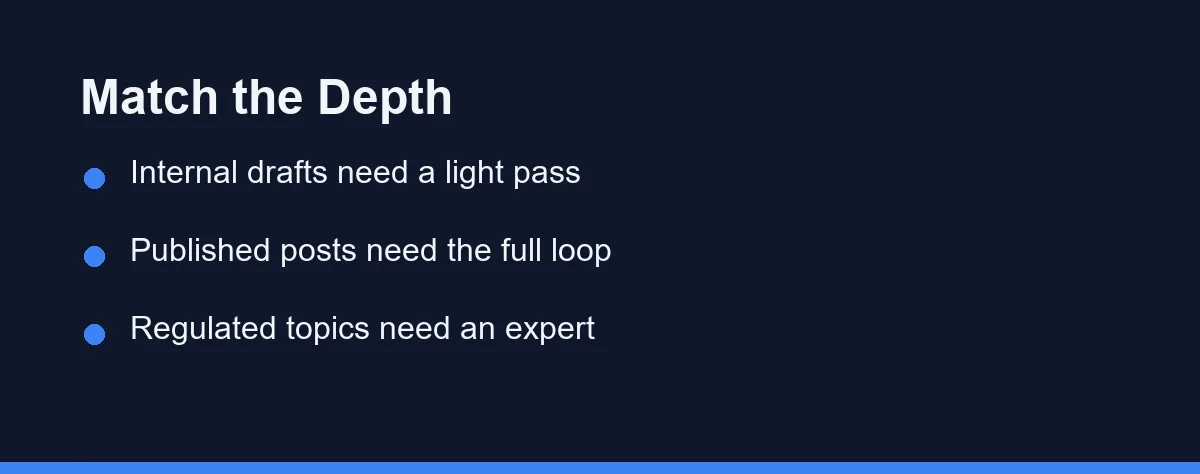
The internal memo or brainstorm doc: Run extraction and a spot-check on anything surprising, and stop there. The audience can push back, and the cost of a wrong detail is a correction in a meeting.
The published blog post: Run the full twenty-minute pass, with the sourcing step weighted heaviest. Public claims compound, and search traffic keeps arriving long after you stopped thinking about the page.
The newsletter with product or price claims: Add a same-day recheck of every perishable fact before sending, because email cannot be edited after the fact. Perishables are the class that rots between draft and send.
The content team at volume: Standardize the claim log and make it a handoff artifact between writer and editor. Consistency across writers matters more than any individual pass, and our best AI writing tools roundup notes which drafting tools keep sources attached to text.
The regulated publisher in health, finance, or law: The workflow above is the floor, and a qualified human reviewer is the actual gate. Model fluency is at its most dangerous exactly where wrong answers carry liability.
The solo creator on a deadline: If time forces triage, verify the top damage tier and cut every claim you cannot check. A shorter true piece beats a longer unverified one every single time.
Fact-Checking Mistakes That Let Errors Through
Verifying by vibes is the default failure, where the checker rereads the draft and confirms it still sounds right. Sounding right is the one property AI errors always have.
Asking the model to check itself is the second. It produces a confident audit from the same habits that produced the mistake, and agreement between the two proves nothing.
Confirming a claim with a page that cites the same rumor is circular sourcing, and AI-written content has made it common. Two sites repeating one unverified figure is one source, not two.
Checking only the claims that look suspicious inverts the actual risk. The fluent, boring, specific sentences are where fabrication hides, which is why extraction comes before judgment.
Skipping the recheck at republication lets true claims decay into false ones. Facts have shelf lives, and the log you kept in step six is what makes expiry visible.
Publish Only What Survived the Queue
Fact-checking AI writing is not a talent, and it is a queue discipline. Extract the claims, rank them by damage, trace them to sources that existed first, and give numbers and quotes their own pass.
The workflow costs about twenty minutes per article and removes the exact failure mode that burns publishers of AI-assisted content. Speed from the model plus verification from you is the whole sustainable bargain.
Keep the log, respect the perishables, and let unverifiable claims die in the draft. What ships after that is simply writing you can stand behind.
Coursework holds the same line under a different name, where the risk is authorship rather than accuracy. Grammarly vs QuillBot for students compares the two tools most likely to blur that boundary in an assignment.
Detection scores sit on the other side of the same trust problem, and the statistics behind them are older than most people assume. Perplexity and burstiness explained sets out what those numbers ever measured.
Transcripts carry the same risk in a different shape, because a misheard name or figure reads as fact once it sits in a quote. How to check an AI transcript before you publish it sets out the passes worth making before it ships.
Research drafts fail earlier than the fact-checking stage, because a fabricated citation looks perfectly correct until someone opens the catalog. How to use AI for research without ending up with fake sources covers the grounding choices that stop the problem upstream.
FAQ
What is the fastest way to fact-check an AI-written draft?
Extract the checkable claims first, then verify each against a source that existed before the draft did. Prioritize names, numbers, dates, quotes, and anything that could harm a reader if wrong. A claim without a findable source gets cut or reworded, not kept on faith.
Can I use another AI to fact-check AI writing?
No. Asking a model to verify its own output mostly produces a confident second opinion from the same statistical habits that made the first error. Models can help you locate sources and extract claims, but the confirmation step needs an independent document or database.
Which parts of an AI draft are most likely to be wrong?
Citations, statistics, quotes, and specifics about small or recent subjects fail most often. Models reproduce the shape of a reference more reliably than its contents, so a real-looking source is not evidence of a real source. Broad, well-documented explanations fail least.
How long does fact-checking an AI draft actually take?
For a standard blog post, a focused pass takes twenty to forty minutes once the workflow is routine. High-stakes content in health, finance, or law takes longer and deserves a qualified reviewer. The time scales with the number of claims, not the word count.
Should I document my fact-checking process?
Keep a simple log of each claim, the source that confirmed it, and the date you checked. The log turns a vague sense of having checked into evidence, and it makes updates fast when facts change. Prices and policies deserve a recheck on the official site as of 2026 before every republication.
Sources
- Vectara: Hallucination Leaderboard — checked 2026-09-27
Some links may be affiliate links. We may earn a commission at no extra cost to you.
This article was written with AI assistance. It is researched and fact-checked, not based on personal hands-on testing unless explicitly stated.
Comments
Post a Comment