Wrong Answers That Sound Exactly Like Right Ones
Most people meet this problem the same way. They ask something they happen to know the answer to, and the chatbot gets it wrong with total composure.
There is no hesitation in the reply. No hedge, no wobble, no change in tone. The invented answer arrives in exactly the voice the correct ones use.
That is the part worth understanding, because it breaks the instinct everyone relies on with human experts. We judge reliability partly by how someone sounds when they are unsure, and that signal simply does not exist here.
This guide explains what is actually happening, which questions reliably trigger it, and the checks that catch a fabrication in about a minute.
The Word “Hallucination” Hides the Mechanism
The industry settled on a misleading term. Hallucination suggests a malfunction, a glitch, something going wrong in an otherwise reliable process.
Nothing goes wrong. The system does exactly what it was built to do, and an invented fact is produced by the same machinery that produces a correct one.
That distinction matters practically rather than philosophically. If invention were a bug, you could wait for a fix. Because it is a property of the design, you need habits instead.
Confabulation is the closer word. It describes filling a gap with something plausible, without any awareness that a gap was filled.
Prediction Is Not Retrieval
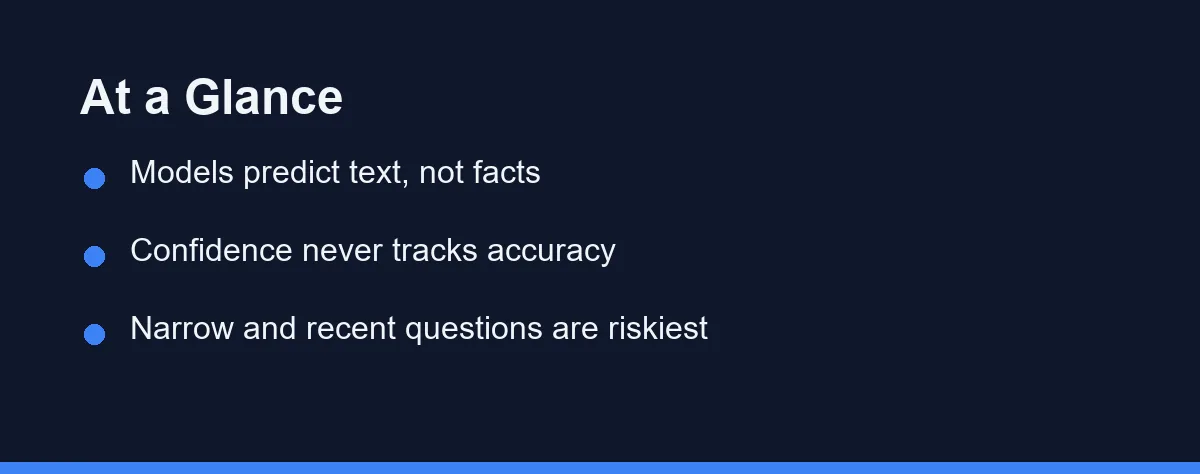
A language model answers by predicting what text should come next, one piece at a time, based on patterns learned from an enormous amount of writing.
It does not hold a database of facts that it consults. There is no lookup step, no record with a source attached, and no internal marker separating something learned thoroughly from something half-seen.
When you ask about a common fact, the pattern is strong and the prediction lands on the truth. When you ask about something narrow, the pattern for the shape of an answer is still strong even though the specific content is missing.
So the model produces the shape. A plausible number, a plausible name, a plausible citation, formatted perfectly and grounded in nothing.
Six Situations That Reliably Trigger Invention
Fabrication is not random. It clusters around predictable conditions, and knowing them lets you raise your guard selectively.
Specific numbers are the classic case. Prices, statistics, market sizes, and version numbers all have a familiar format and a value the model may never have reliably learned.
Recent events fall outside the training cutoff. The model does not know what it missed, so it answers from an older world with no sense that time has passed.
Obscure entities invite confident invention. A well-known company gets described accurately, while a small local business gets a plausible biography assembled from nothing.
A 2025 paper by OpenAI researchers makes the link concrete. It argues that if 20% of birthday facts appear exactly once in the training data, base models should be expected to invent answers for at least 20% of birthday facts.
Quotations and citations are highly patterned and therefore easy to construct. So are legal citations, product model numbers, and API signatures.
Leading questions do real damage. Asking “why does X cause Y” when X does not cause Y usually produces a fluent explanation rather than a correction.
Multi-step arithmetic drifts, because each step is generated as text rather than calculated, unless the tool runs actual code.
Why Confidence Never Drops
The tone question deserves its own answer, because it is the single most dangerous property of these systems.
Fluency and accuracy are produced by the same process. The model is not first deciding whether it knows something and then choosing how to phrase it.
Training makes this worse in a subtle way. Systems tuned on human preference ratings learn that people prefer direct, helpful answers over hedged ones, so hedging gets trained down.
Some products now attach source links or surface uncertainty explicitly, and those features genuinely help. The underlying prose still carries no reliable signal, which is why the checks below matter more than reading tone.
Risk by Question Type
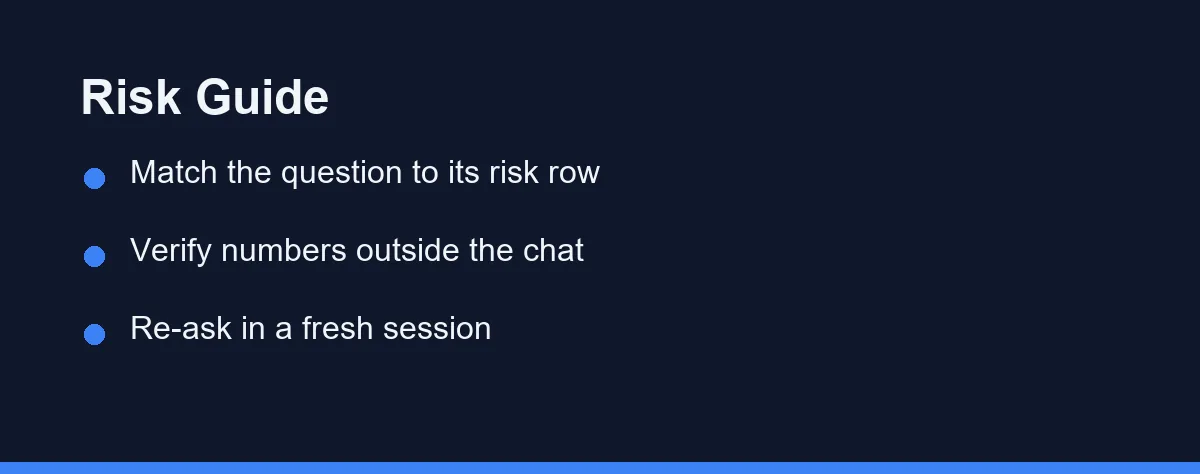
The table sorts common question types by risk and pairs each with the check that actually works.
| Question type | Risk level | What failure looks like | Check that works |
|---|---|---|---|
| Explain a general concept | Low | Slight oversimplification | Skim one reference source |
| Rewrite or summarize my text | Low | Meaning drift, added claims | Compare against your original |
| Current price or plan details | High | Confident outdated figures | Open the vendor’s pricing page |
| Statistics and study findings | High | Real-sounding numbers, no source | Find the primary source yourself |
| Quotations and citations | Very high | Perfect format, nonexistent item | Search the title in a real index |
| Details about a small company or person | Very high | Fluent invented biography | Check the official site directly |
| Legal, medical, or tax specifics | Very high | Plausible but jurisdiction-wrong | Consult a qualified professional |
Read the risk column as a guide to attention, not as a ban. The low rows are where these tools genuinely save time, and the high rows are where the time saved gets repaid with interest later.
One rule covers the whole table. The more specific and checkable a claim is, the more likely it needs checking.
What Grounding Actually Changes
Connecting a model to real documents changes the failure profile substantially, and it is the biggest practical improvement available.
Retrieval-based tools search first and answer from what they found, attaching links as they go. Perplexity works this way, and the search modes inside major assistants do something similar.
Document-grounded tools go further by restricting the answer to files you uploaded. If every claim traces to a document sitting in your own folder, whole-cloth invention has nowhere to originate.
Neither approach is a guarantee. A grounded tool can still misread a table, flatten a hedged finding into a firm one, or cite a page that is itself wrong. Our Perplexity vs ChatGPT comparison covers when the citation-first approach is worth the trade.
Habits That Catch It in Under a Minute
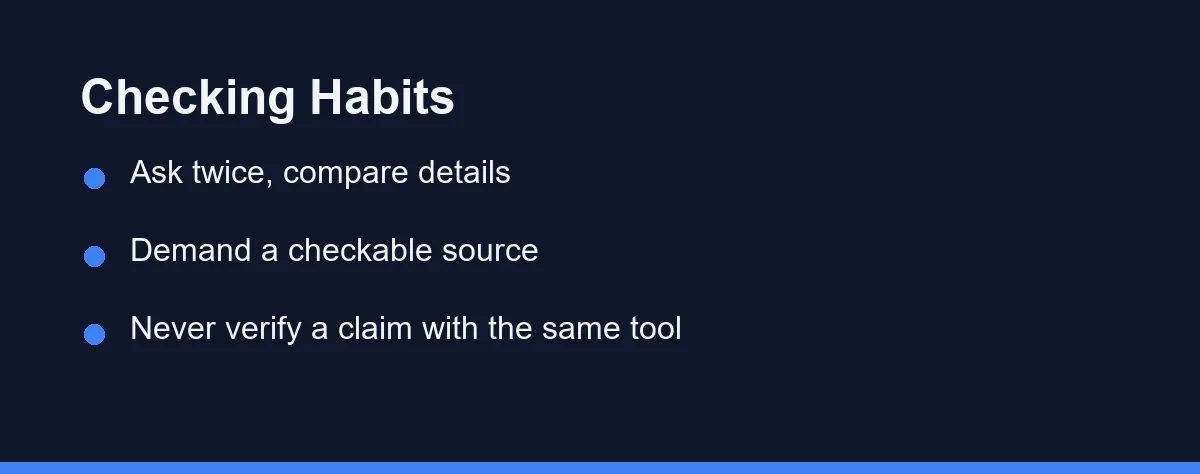
Four checks catch the overwhelming majority of fabrications, and none takes long.
Ask the same question again in a fresh session. Genuine knowledge stays stable, while invention tends to vary in its details, which makes inconsistency a useful signal.
Ask for a source you can open, then open it. Refusal, vagueness, or a link that does not resolve tells you what you need to know.
Verify outside the tool that produced the claim. Asking a model to check its own answer produces agreement rather than verification, since the same process runs again.
Watch for suspicious precision. An oddly exact figure with no source attached is more often a construction than a recollection.
What This Means for Anything You Publish
The stakes change completely once an answer leaves your screen.
Anything customer-facing carries your name rather than the vendor’s. A wrong price in a proposal, an invented statistic in a blog post, or a fabricated case study is your error in every way that matters.
The practical division is to let these tools handle language and keep facts under your control. Drafting, restructuring, and rephrasing are safe. Supplying the numbers is not.
That division also produces better writing, because specific detail you actually verified is what makes content worth reading. Our best AI tools for small business guide covers where that split fits into a working stack.
Which Tasks Should You Never Delegate Unchecked
Anything with a number in it: Prices, percentages, dates, and measurements all need a source you opened yourself. This is the single highest-yield rule in the guide.
Anything you will quote or cite: Quotations and references are the easiest things to fabricate and the most damaging to get wrong. Verify the item exists before the wording matters.
Anything about a specific person or small organization: Obscurity is the strongest predictor of invention. Check the official site rather than accepting a fluent summary.
Anything legal, medical, or financial: Rules vary by jurisdiction and change often, and a confident wrong answer here has real consequences. Use a chatbot to prepare questions, not to answer them.
Anything that ships to customers: Marketing copy, proposals, and documentation all carry your credibility. Language help is fine, and unverified facts are not. Our best AI chatbots for business guide covers customer-facing deployments where this matters most.
A Useful Amount of Distrust
None of this argues against using these tools. It argues for using them the way you would use a fast, widely read, occasionally overconfident colleague.
You would accept that person’s draft, structure, and explanation of an unfamiliar idea without much friction. You would check their numbers before putting them in front of a client.
That posture costs almost nothing and removes almost all of the risk. The people who get burned are the ones who mistake fluency for reliability.
Keep the split clear. Language from the tool, facts from a source, and judgment from you. If you are still deciding which assistant to make your default, our ChatGPT vs Claude vs Gemini comparison is a reasonable place to start.
Some of what looks like invention is really a conversation that outgrew its memory. Our explainer on what a context window is covers why a long chat quietly drops the instruction you set an hour ago.
FAQ
Why does an AI chatbot give confident answers that are completely wrong?
Because it predicts likely text rather than looking anything up. When the pattern is familiar but the specific fact is missing from what it learned, the most fluent continuation is an invented one. Nothing in the process distinguishes recall from construction.
Can I tell from the wording that an answer is unreliable?
No. Tone is generated the same way as content, so a fabricated answer arrives in the same steady voice as a correct one. Some tools now flag low confidence or attach sources, and that helps, but the prose itself carries no signal.
Which kinds of questions are riskiest?
Anything narrow, recent, or numeric. Prices, statistics, version numbers, quotations, citations, obscure people, and local rules are the highest-risk categories, because the pattern is familiar while the specific value is not.
Does connecting a chatbot to search or my own files fix the problem?
It reduces one class of error substantially. Answering from documents you supplied or pages it retrieved gives every claim somewhere to come from, but the tool can still misread the source or overstate a hedged finding.
What is the quickest way to test an answer I am unsure about?
Ask the same question in a fresh session and compare. Genuine knowledge stays stable across attempts, while invention tends to change details each time, which is the fastest single check available.
Sources
- arXiv: Why Language Models Hallucinate (Kalai et al., OpenAI) — checked 2026-09-27
Some links may be affiliate links. We may earn a commission at no extra cost to you.
This article was written with AI assistance. It is researched and fact-checked, not based on personal hands-on testing unless explicitly stated.
Comments
Post a Comment