Pro Pays Off Only When You Run a Structured Review
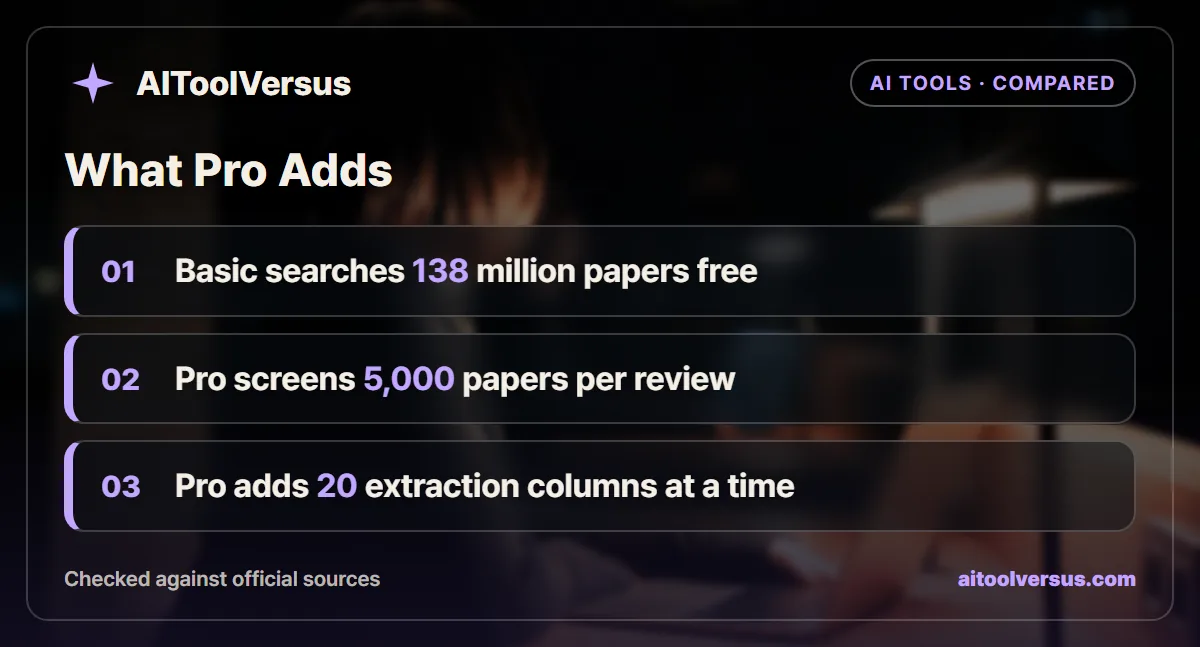
Stay on Elicit Basic if you mainly find and read papers, and pick Pro only for a structured systematic review. The Elicit pricing page lists unlimited search across more than 138 million papers on Basic, as of November 2026. Pro costs $49 per user a month, billed as $588 a year.
What Pro buys is a dedicated systematic review workflow that screens 5,000 papers, plus data extraction across 20 columns at a time. If your project has no screening stage and no extraction table, Basic already covers the work. All figures come from the Elicit pricing page and the Elicit Help Center, checked in November 2026. Confirm current pricing on the official site before subscribing.
What Basic Already Does for Free
Basic is more useful than most free tiers. Search across more than 138 million papers is unlimited, and so are summaries and chat with full-text papers.
Basic also lets you view the sources behind each answer and import from Zotero. For a student writing an essay or a professional checking what the evidence says, that covers the core job.
The limits sit elsewhere. Basic lists limited usage for the Research Agent and Research Reports, which are the features that draft structured answers across many papers at once. Elicit does not publish how much limited means, so treat Basic as a place to search and read, not to run a full review.
How the Monthly Usage Pool Works
Elicit replaced its old per-feature counts with a single monthly pool. The Help Center article on usage limits says the older per-workflow counts and daily Research Agent caps were removed.
The pool refreshes on your subscription date each month, including on annual plans. Unused usage does not roll over, so a quiet month loses whatever is left.
When you reach the limit, the Find Papers skill keeps working on every plan until the reset. Pro and Scale users can switch on extra usage with a monthly spend limit, and Elicit bills it in $100 increments. Set that limit low at first, because the article does not say how much work $100 buys.
Basic, Pro and Scale on One Page
The table uses the Elicit pricing page as of November 2026. Prices are per user per month on annual billing.
| Feature | Basic | Pro | Scale | Enterprise |
|---|---|---|---|---|
| Price | $0 | $49, billed $588 a year | $229, billed $2,748 a year | Custom |
| Paper search | Unlimited, 138 million+ papers | Unlimited | Unlimited | Unlimited |
| Research Agent and Reports | Limited usage | Standard usage | 5x Pro usage | Custom usage |
| Systematic review screening | Not listed | 5,000 papers | Not stated | 40,000 papers |
| Extraction columns at a time | Not listed | 20 | 30 | 40 |
| Report data sources | Not listed | Up to 135 | Up to 200 | Custom |
| Figure extraction | Not listed | Not listed | Included | Not listed |
| Collaboration | Not listed | Not listed | Live editing and admin panel | SSO and SAML |
| API access | Not listed | Included | Not listed | Unlimited |
Pro also lists Routines, custom extractions from uploaded papers, explanations for AI-generated answers and multiple output templates. Each plan card lists only what that plan highlights. A cell marked not listed means the page does not mention the feature there, not that Elicit confirms it is missing.
Pro Features That Matter Beyond Screening
Screening gets the attention, but several Pro features help with smaller projects too. Custom extractions from uploaded papers let you pull the same fields from PDFs you already hold, including papers outside the Elicit database.
Reports on Pro extract from up to 135 data sources, against 200 on Scale. The page does not define a data source further, but a higher ceiling lets one report draw on a wider evidence base.
Explanations for AI-generated answers show why the tool filled a cell the way it did. That makes checking faster, because you can see which passage it relied on before you open the paper.
Routines and multiple output templates suit repeat work, such as a monthly evidence update on the same question. API access is listed on Pro as well, which matters only if someone on the team writes code against it.
The 5,000-Paper Cap Is the Number to Check First
Most systematic reviews begin with a database search that returns thousands of records. The Pro screening workflow handles 5,000 papers, which is the figure that decides whether Pro can carry your review at all.
Count records after removing duplicates, not before. Databases overlap heavily, and the deduplicated total is what you actually screen.
If your total lands well above 5,000, you have two honest options. Tighten the search terms until the result fits, or look at Enterprise, which lists screening for 40,000 papers. Scale does not state a screening figure, so ask Elicit before assuming it is higher than Pro.
A Thesis Review Worked Through
Consider a master’s student running a systematic review across three databases. The search returns 2,900 records from PubMed, 2,400 from Scopus and 1,700 from Web of Science.
Assume 30% of the records are duplicates, which is an illustrative figure and not an Elicit number. Assume an extraction form of 26 fields, covering items such as design, sample size, population, intervention and outcomes.
| Step | Calculation | Result |
|---|---|---|
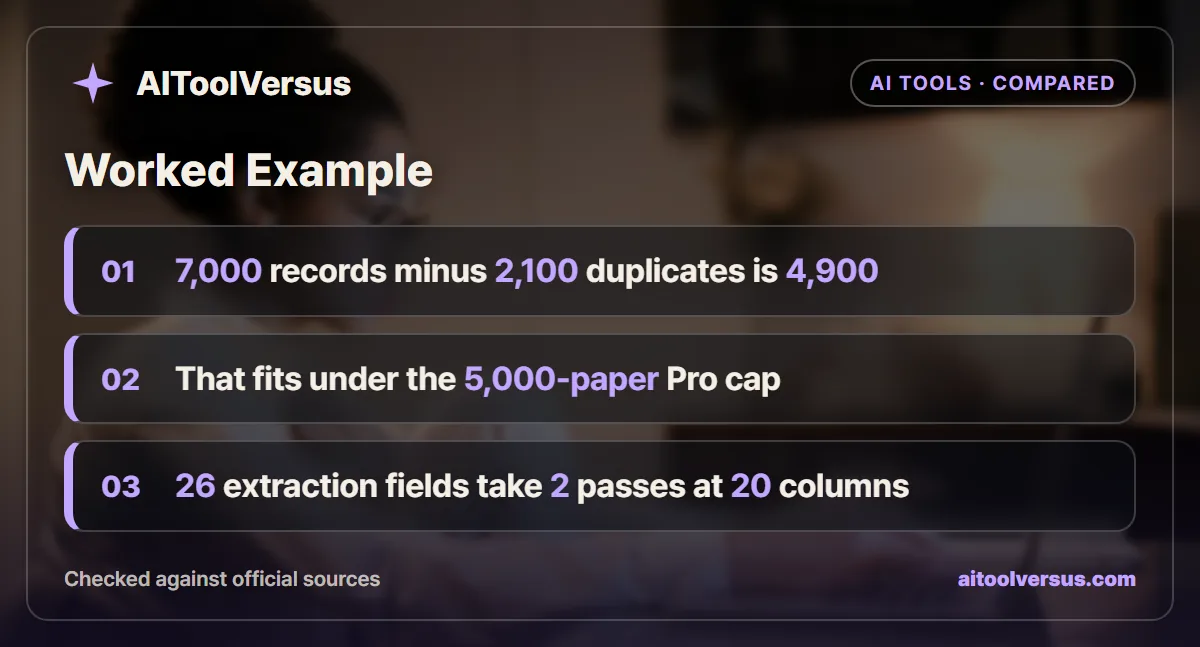
| Records found | 2,900 + 2,400 + 1,700 | 7,000 |
| Duplicates at 30% | 7,000 x 0.30 | 2,100 |
| Records to screen | 7,000 - 2,100 | 4,900 |
| Room under the Pro cap | 5,000 - 4,900 | 100 spare |
| Extraction passes on Pro | 26 fields at 20 columns | 2 passes |
| Extraction passes on Scale | 26 fields at 30 columns | 1 pass |
The review fits on Pro with almost no margin. One more database or a looser search string would push it over 5,000. The extraction form needs two passes on Pro, which costs time rather than money.
The example shows that the screening count, not the price, is the first thing to test before paying for Pro.
A Lighter Project That Stays on Basic
Now consider an undergraduate writing a 3,000-word essay that needs around 25 solid references. The figures here are illustrative, not Elicit limits.
Search, summaries and chat with full-text papers are all unlimited on Basic. The student can find candidates, read summaries, ask follow-up questions of each paper and export the keepers to Zotero without paying.
The only Basic feature with a ceiling is the Research Agent and Research Reports. Save those for the one or two broad questions where a structured overview helps, and do the rest by search and reading.
There is no screening stage and no extraction table in this project. Pro would add nothing the essay needs, which is why most coursework never justifies the upgrade.
Monthly or Annual Billing for a Short Project
The pricing page shows Pro at $49 per user a month billed annually, and labels the annual plan a 35% saving. A 35% discount means the annual price equals 7.8 months of monthly billing.
That gives a simple break-even rule. If your project needs Pro for fewer than about 8 months, monthly billing costs less in total than the annual plan. If you will use it most of the year, the $588 annual price is the cheaper route.
A thesis with a six-month review phase falls on the monthly side of that line. Check the monthly price on the pricing page toggle before you commit, since the 35% label is the only monthly figure the page states directly.
When Scale Makes More Sense Than Two Pro Seats
Scale costs $229 per user a month billed annually, or $2,748 a year. It lists 5x the Pro usage for the Research Agent, Reports and systematic reviews.
Per unit of usage, Scale is slightly cheaper. Dividing $229 by 5 gives $45.80 for each Pro-sized share, against $49 for Pro itself. The Help Center adds that Scale pools usage across seats, so a 4-member team has 4x the usage of one person.
The bigger reasons to choose Scale are figure extraction, live editing and the admin panel. A lab that reviews together and needs data pulled from charts gets more from those than from the small per-unit saving.
Academic and Nonprofit Pricing
Elicit sells academic plans, chosen from a dropdown in the plans section of the pricing page. The Help Center describes them as offering significant savings compared to industry pricing, but it publishes no figure.
The same article says complimentary access is not available. Nonprofits have no separate discount and are pointed to the academic plans, which Elicit calls its lowest available pricing tier.
Check the Academic option before paying the standard $49 rate. Elicit also mentions institutional contracts on its Help Center, so ask your library whether one already covers you.
Accuracy Checks Every Plan Still Needs
Elicit reserves the phrase PRISMA-grade screening and extraction accuracy for Enterprise. On Pro, treat screening and extraction output as a first pass that a person verifies.
That matters for anything you publish or submit. Spot-check excluded papers, confirm extracted numbers against the source tables and keep a log of every decision you override.
Our guide on using AI for research without fake sources explains why paper databases beat chatbot memory. For the wider tool picture, see our roundup of AI tools for students.
Which Elicit Plan Fits Your Research
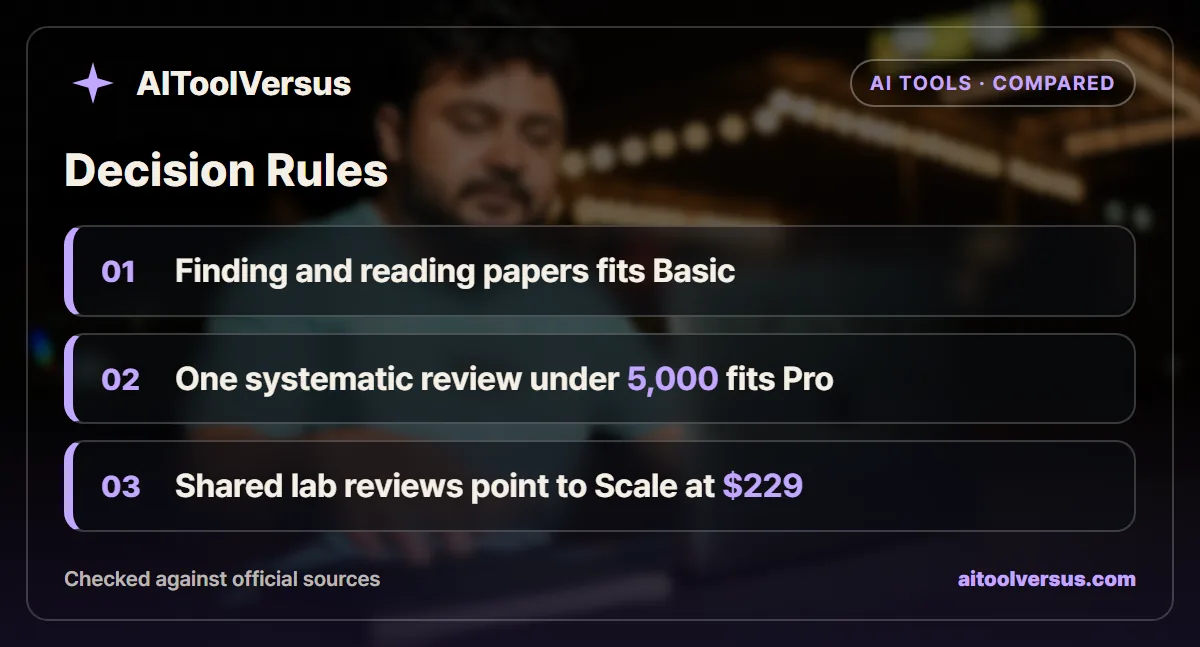
If you mainly search, summarize and read papers: Basic fits. Search, summaries and full-text chat are unlimited across more than 138 million papers.
If you run one systematic review with under 5,000 deduplicated records: Pro fits. The screening workflow and 20-column extraction are the features you are paying for.
If your project lasts under about 8 months: compare monthly billing against the $588 annual price, since the 35% discount only pays off past that point.
If a lab or team reviews together: Scale fits. Pooled usage, live editing and figure extraction justify $229 per seat more than any single feature on Pro.
If your search returns more than 5,000 papers after deduplication: narrow the search or talk to Elicit about Enterprise and its 40,000-paper screening.
Count Your Records Before You Pay
Run your full search strings in each database and deduplicate the results before opening a Pro subscription. That one number tells you whether Pro can finish the job.
Then list your extraction fields and divide by 20 to see how many passes the work will take. Both checks cost nothing, and Basic search is enough to run them.
Confirm current pricing and limits on the official site before subscribing. Elicit has already replaced its per-feature counts with a single usage pool, and the size of each pool may move again.
Once the screened papers are in hand, many researchers load them into a notebook tool to ask questions across the full set. Our guide on whether NotebookLM Pro is worth it shows how the free 50-source cap compares with a typical review.
FAQ
How much does Elicit Pro cost?
The Elicit pricing page lists Pro at $49 per user a month, billed as $588 a year, as of November 2026. The page labels annual billing as a 35% saving. Elicit also offers academic pricing through a dropdown on the plans section, but publishes no academic figure. Confirm current pricing on the official site.
How many reports does Elicit Basic allow?
Elicit does not publish a number. Its usage limits article says each plan has one monthly usage pool, which refreshes on your subscription date and does not roll over. Basic lists limited usage for the Research Agent and Research Reports, while Pro lists standard usage.
Can you search papers on Elicit for free?
Yes. Basic lists unlimited search across more than 138 million papers, unlimited summaries and unlimited chat with full-text papers. The limits apply to the Research Agent, Research Reports and systematic review workflow, not to plain paper search.
How many papers can Elicit Pro screen in a systematic review?
On Pro, the dedicated systematic review workflow can screen 5,000 papers. Scale does not state a screening figure, and Enterprise lists 40,000 papers with 40 extraction columns. Larger reviews need either a narrower search or Enterprise.
What happens when you hit the Elicit usage limit?
On all plans, the Find Papers skill keeps working until the usage pool resets. Pro and Scale users can turn on extra usage with a monthly spend limit, and Elicit bills that extra usage in $100 increments.
Sources
- Elicit plans and pricing — checked 2026-11-05
- Elicit Help Center: Usage limits in Elicit — checked 2026-11-05
- Elicit Help Center: Academic and nonprofit pricing — checked 2026-11-05
Some links may be affiliate links. We may earn a commission at no extra cost to you.
How this article was made: it was drafted with AI assistance from the official sources listed above, and its figures were checked against those pages on the dates shown. It is not based on personal hands-on testing.
Comments
Post a Comment